
When the markets turn turbulent, one of the first places investors notice the effects is in their mutual fund NAVs (Net Asset Values). Understanding market volatility — and indicators like the VIX Index or CBOE Volatility Index — can help investors make sense of short-term price swings and long-term opportunities.
In this blog, we’ll explore how market volatility affects mutual fund NAVs, what drives these changes, and how investors can respond wisely when the volatility index spikes.
What is Market Volatility?
In simple terms, market volatility measures how rapidly prices fluctuate in the stock market. When markets rise and fall sharply within a short time, volatility is said to be high.
Financial analysts often track the VIX Index, also known as the CBOE Volatility Index, to gauge investor fear or optimism. A higher VIX index value usually indicates higher expected volatility — or, in other words, greater market uncertainty.
Related Terms:
- Volatility Index (VIX): Commonly called the “fear gauge,” it tracks expected 30-day market volatility based on S&P 500 options.
- CBOE Volatility Index (VIX): Developed by the Chicago Board Options Exchange, this is the most widely followed measure of U.S. market volatility.
- Nifty VIX: India’s equivalent, reflecting volatility expectations in Indian markets.
Learn how our Mutual Fund Distribution Services help investors stay on track during market fluctuations.
How Market Volatility Impacts Mutual Fund NAVs
1. Equity Funds Feel It First
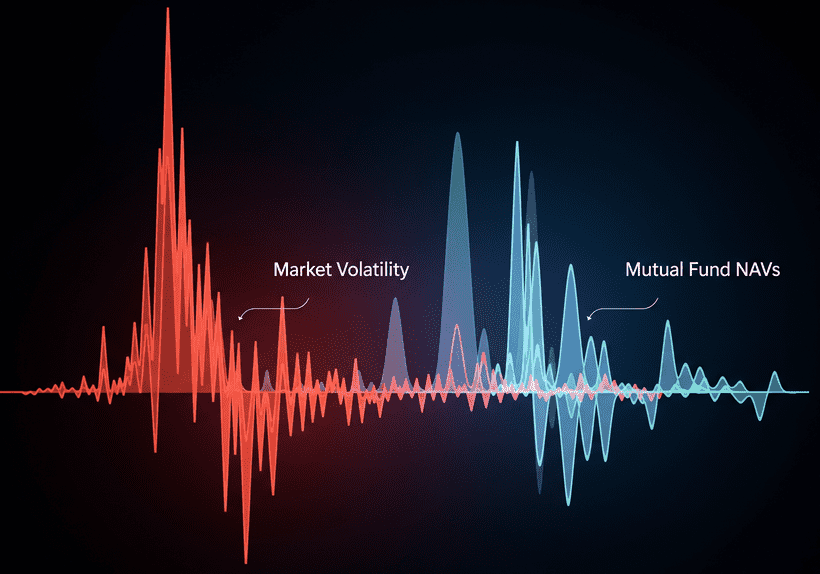
When stock markets experience swings, equity mutual fund NAVs react almost immediately. That’s because these funds invest directly in equities whose prices reflect market sentiment and liquidity.
For example, if the VIX index today spikes due to geopolitical tension or rate hike fears, mutual fund NAVs in equity schemes often dip temporarily as stock prices adjust.
2. Debt Funds Are Not Immune
While debt mutual funds are considered safer, rising volatility and inflation expectations can lead to bond yield fluctuations, affecting their NAVs too. Investors often overlook that bond market volatility can erode short-term returns in fixed income portfolios.
3. Sectoral and Thematic Funds React Differently
Volatility does not affect all funds equally. For instance, low volatility stocks or defensive sectors like FMCG and utilities may hold steady, while high volatility stocks in tech or small-cap segments may experience sharper movements.
Understanding the VIX Index and Its Connection to Mutual Funds
The VIX Index serves as a real-time barometer of market sentiment. A rising CBOE VIX or Nifty VIX signals increasing uncertainty, often leading to corrections or consolidation phases.
How It Works:
- A VIX index level above 20 indicates higher fear or volatility.
- Levels below 15 generally signal market stability.
- Traders often refer to CBOE VIX futures or VIX stock price charts to forecast market direction.
Why It Matters for Mutual Fund Investors:
When volatility spikes:
- NAVs decline temporarily as prices correct.
- Systematic Investment Plans (SIPs) benefit by purchasing more units at lower prices.
- Long-term investors can see volatility as an opportunity rather than a risk.
Explore how our SIP Planning Guide helps navigate volatility effectively.
Short-Term Pain vs Long-Term Gain
Short-Term Impact:
Volatility leads to fluctuating daily NAVs, which may worry investors monitoring portfolios closely. Funds exposed to most volatile stocks or sectors can show sharper daily movements.
Long-Term Perspective:
Over a 5–10 year horizon, market volatility averages out, allowing well-diversified funds to benefit from compounding and recovery phases.
Experienced investors use this period to rebalance portfolios and add units when markets fall, turning volatility into a long-term advantage.
Read our insights on Building a Resilient Mutual Fund Portfolio.
How to Manage Mutual Fund Investments During Volatile Markets
- Stick to SIPs: Regular investments help average out purchase costs over time.
- Diversify Wisely: Mix equity, debt, and hybrid funds to balance risk.
- Avoid Panic Selling: Volatility is temporary; selling at lows locks in losses.
- Monitor the Volatility Index (VIX): Helps gauge sentiment before making allocation decisions.
- Consult a Financial Advisor: Professional guidance ensures risk and goal alignment.
Role of the VIX Index in Global and Indian Context
While the CBOE Volatility Index (VIX) measures U.S. market volatility, India’s Nifty VIX performs a similar function for Indian equities.
For example:
- When Nifty VIX rises sharply, it often precedes short-term corrections.
- During calmer phases, a falling VIX index correlates with steady or rising mutual fund NAVs.
Understanding these patterns helps investors remain data-driven rather than emotion-driven in their investment decisions.
Volatility in Finance: Beyond Equities
Volatility isn’t limited to stocks — it affects all financial assets, including bonds, commodities, and currencies.
- Bond Volatility Index: Measures uncertainty in fixed-income markets.
- Forex Volatility Index: Indicates risk in currency movements.
- Gold Volatility Index: Reflects investor behavior during global uncertainty.
Each of these plays a role in determining how mutual funds across categories perform during different market phases.
Final Thoughts
Volatility is an inevitable part of investing. While it affects mutual fund NAVs in the short term, long-term investors who remain disciplined often emerge stronger. The VIX index and market volatility index are useful tools to understand sentiment — but they shouldn’t drive impulsive decisions.
The key is to stay invested, stay diversified, and use volatility as a chance to accumulate more at lower prices through systematic investing.
📌 Key Takeaways
- Market volatility directly impacts mutual fund NAVs, especially equity funds.
- The VIX index serves as a barometer of market fear and helps anticipate short-term movements.
- SIPs and diversification remain the best strategies to manage volatility.
- Long-term focus helps investors turn short-term volatility into long-term opportunity.
🧾 Disclaimer
This article is for educational and informational purposes only and does not constitute investment advice. Market conditions, volatility levels, and mutual fund NAV performance may change over time. Investors should consult a SEBI-registered financial advisor before making investment decisions related to mutual funds, VIX index, or market volatility index.
FAQs on How Market Volatility Affects Mutual Fund NAVs
1. What is a Mutual Fund NAV and how is it calculated?
A Mutual Fund NAV (Net Asset Value) represents the per-unit value of a mutual fund.
It’s calculated as:
(Total Assets – Total Liabilities) ÷ Number of Outstanding Units.
In both India and the U.S., the NAV changes daily based on the closing market value of the fund’s holdings.
2. How does market volatility impact mutual fund NAVs?
When markets fluctuate sharply, the value of underlying securities in a mutual fund changes — directly affecting its NAV.
- In a bullish market, NAVs tend to rise as stock prices increase.
- In a bearish or volatile market, NAVs may drop temporarily.
However, long-term investors often recover as markets stabilize.
3. Why do equity mutual funds react more to market volatility than debt funds?
Equity mutual funds invest in stocks, which are more sensitive to market sentiment, earnings, and global news, leading to greater NAV swings.
In contrast, debt funds invest in bonds or fixed-income securities, which are less volatile but can be impacted by interest rate changes — especially in the U.S. Federal Reserve or RBI rate policy contexts.
4. How should investors handle mutual fund investments during market volatility?
Instead of reacting emotionally, investors should:
- Continue Systematic Investment Plans (SIPs) to average purchase cost.
- Focus on long-term goals instead of short-term market noise.
- Diversify across asset classes (equity, debt, gold) for better risk balance.
Volatility offers buying opportunities for disciplined investors.
5. Does global market volatility affect mutual funds in India and the U.S.?
Yes. Global events such as Federal Reserve policy shifts, geopolitical tensions, or BRICS and U.S. trade tariffs can affect both Indian and American markets.
This ripple effect can temporarily influence NAVs of funds with international exposure or sectors linked to global trade.
6. Why does NAV fall even when the market seems stable?
A fund’s NAV can decline even in calm markets if:
- The fund has exposure to underperforming sectors (like tech or small-caps).
- Currency fluctuations affect overseas investments.
- Dividend payouts reduce the NAV temporarily without affecting total returns.
7. Is it a good idea to redeem mutual funds during high volatility?
Not necessarily. Exiting during volatility can lock in losses.
Instead, investors should review:
- Their investment horizon
- Risk tolerance
- Fund performance vs benchmark
If the fund’s fundamentals are strong, holding or continuing SIPs is usually wiser.
8. How do fund managers manage volatility in NAVs?
Professional fund managers use strategies like:
- Sector rotation (shifting between defensive and growth sectors)
- Cash allocation adjustments
- Hedging via derivatives (especially in U.S. funds)
- Active rebalancing to align with fund objectives and control downside risk.
9. How does interest rate movement affect NAVs in debt mutual funds?
In both India and the U.S., bond prices move inversely with interest rates.
When RBI or the U.S. Fed hikes rates, bond prices fall — lowering debt fund NAVs. Conversely, rate cuts boost bond prices and NAVs.
Duration-focused funds are most affected by these rate shifts.
10. How can investors reduce the impact of volatility on their mutual fund portfolio?
Investors can:
- Maintain a balanced portfolio of equity and debt funds.
- Use SIPs or STPs (Systematic Transfer Plans).
- Avoid timing the market.
- Review asset allocation annually to stay aligned with goals.
Long-term investing smooths out the effects of short-term NAV fluctuations.
11. How does currency volatility affect mutual fund NAVs?
For international or U.S.-based mutual funds, currency movements (like USD–INR fluctuations) can impact NAVs.
A weakening rupee increases returns for Indian investors in U.S. funds, while a strengthening rupee may reduce them — even if the fund performs well in dollar terms.
12. What should new investors keep in mind about NAV and returns?
A lower NAV doesn’t mean cheaper or better, and a higher NAV doesn’t mean expensive.
Performance depends on portfolio quality and market conditions, not the NAV value itself. Always compare returns, expense ratios, and fund objectives before investing.