
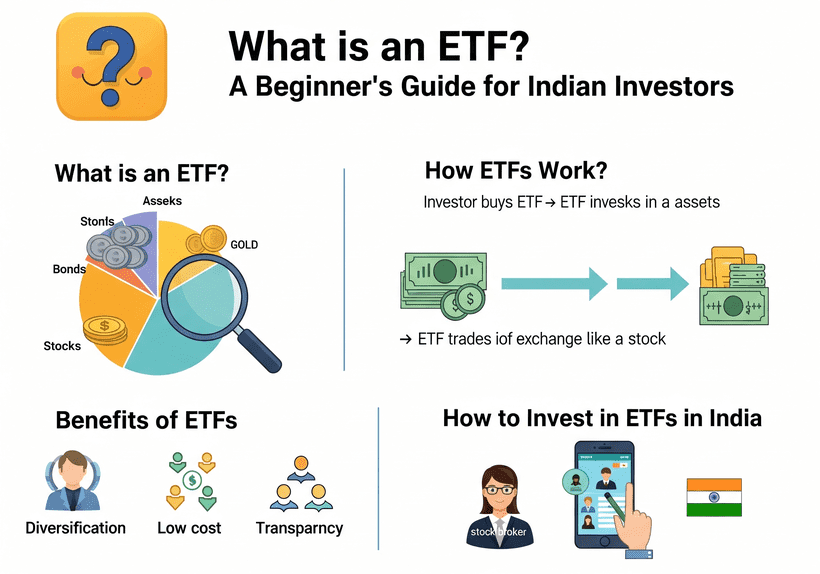
If you’ve ever wondered what “ETF” means when researching investments, you’re not alone. ETFs—short for Exchange Traded Funds—have become one of the most popular investment vehicles worldwide, including in India.
In this guide, we’ll explain what an ETF is, how it works, and how Indian investors can use ETFs to build a diversified, cost-effective portfolio. Whether you’re looking for a gold ETF, index ETF, or a growth ETF, this beginner’s guide will simplify ETFs for you.
🧩 ETF Explained: What is an ETF?
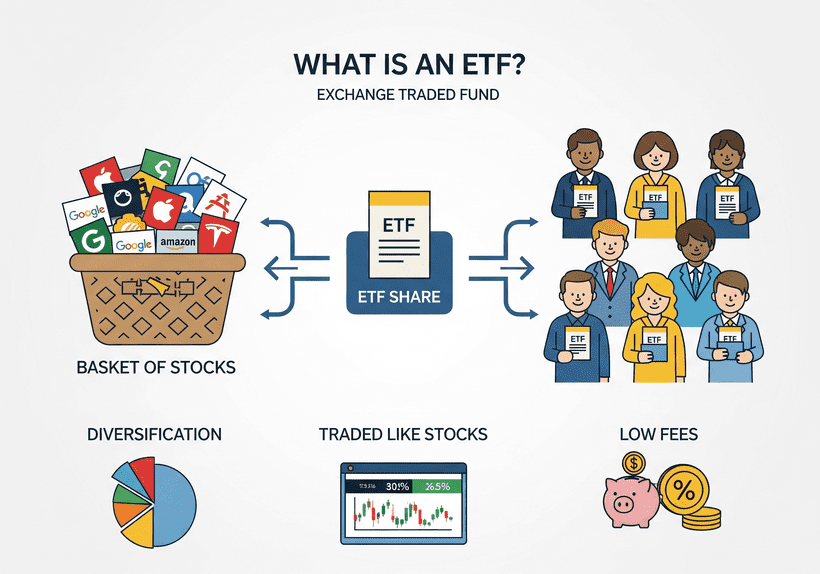
An ETF (Exchange Traded Fund) is a type of pooled investment product that tracks a specific index, commodity, or sector. It combines the diversification of mutual funds with the real-time tradability of stocks.
For example:
- A Nifty 50 ETF tracks the performance of the Nifty 50 Index.
- A Gold ETF tracks the price of physical gold.
- A Global ETF may track the S&P 500 ETF or NASDAQ 100 ETF.
Unlike mutual funds, ETFs can be bought or sold throughout the trading day on stock exchanges like NSE or BSE—just like regular shares.
💡 How Does an ETF Work?
Each ETF holds a basket of underlying assets—such as stocks, bonds, or commodities. The ETF’s price changes throughout the day based on the value of these assets.
For instance, a Kotak Nifty ETF or Nippon India ETF Nifty BeES replicates the performance of the Nifty 50.
Here’s how it works in three steps:
- Fund Houses create ETF units backed by a basket of securities.
- Investors buy or sell ETF units on the stock exchange.
- Market Makers ensure liquidity by balancing demand and supply.
🏆 Types of ETFs in India
ETFs come in many types, catering to different investment goals.
1. Index ETF
Tracks major indices like Nifty 50, Sensex, or S&P 500 ETF. Ideal for passive investors.
2. Gold ETF
Represents physical gold prices. Examples include HDFC Gold ETF and Nippon Gold ETF.
3. Sector or Thematic ETF
Tracks specific industries like technology ETF, financial ETF, or energy ETF.
4. International ETF
Lets you invest globally in funds like NYSEARCA VGT, VUN Stock, or NYSEARCA VTI.
5. Bond and Govt ETF
Focuses on debt instruments and government securities, such as Bharat Bond ETF.
💰 Benefits of Investing in ETFs
Here’s why ETFs have become a favorite among Indian investors:
- ✅ Low Cost – ETFs usually have lower expense ratios than mutual funds.
- ✅ Diversification – Gain exposure to multiple sectors or assets with one investment.
- ✅ Liquidity – Trade any time during market hours.
- ✅ Transparency – Holdings are publicly disclosed daily.
- ✅ Tax Efficiency – ETFs may offer more efficient tax treatment than traditional funds.
If you’re searching for low-cost ETFs or best ETFs to buy and hold, these advantages make ETFs an excellent choice.
📈 Best ETFs to Buy Now in India (2025)
Here’s a quick list of popular and best-performing ETFs Indian investors often consider:
| Category | Example ETFs | Highlights |
|---|---|---|
| Index ETF | Nippon India Nifty 50 BeES, SBI ETF Sensex | Tracks Indian indices |
| Gold ETF | HDFC Gold ETF, Kotak Gold ETF | Best gold ETF options for portfolio stability |
| International ETF | Motilal Oswal NASDAQ 100 ETF | Exposure to U.S. tech leaders |
| Government Bond ETF | Bharat Bond ETF | Stable returns backed by PSU bonds |
| Smart Beta ETF | ICICI Prudential Nifty Low Vol 30 ETF | Combines low volatility with equity exposure |
If you’re wondering which is the best ETF to buy now, the answer depends on your goals—growth ETF for higher returns, or gold ETF for safety.
🌍 International ETFs: Global Diversification
Many Indian investors are exploring global ETFs like NYSEARCA VOO (S&P 500 ETF), NYSEARCA VGT (Tech ETF), and NYSEARCA VWO (Emerging Markets) for diversification.
Global ETFs allow you to:
- Access developed markets like the U.S.
- Invest in AI ETFs, crypto ETFs, or smart beta ETFs.
- Benefit from global growth sectors such as technology, clean energy, or healthcare.
Before investing in a global ETF, ensure it’s available on Indian exchanges or through international brokers.
⚖️ ETF vs Mutual Fund: What’s Better for Beginners?
| Feature | ETF | Mutual Fund |
|---|---|---|
| Trading | Intraday trading on exchange | End-of-day NAV pricing |
| Costs | Lower expense ratio | Slightly higher fees |
| Transparency | Daily holdings | Monthly or quarterly disclosure |
| Taxation | Similar to mutual funds | Similar |
| Best for | Active or cost-conscious investors | Long-term SIP investors |
Both instruments can coexist in a portfolio. You can simplify ETFs by combining them with mutual funds for a balanced investment strategy.
🧠 Building an ETF Portfolio for Indian Investors
When constructing an ETF portfolio, aim for a balance of growth, income, and stability.
Example Portfolio Mix:
- 40% in Index ETFs (like Nifty 50 ETF or S&P 500 ETF)
- 20% in Gold ETFs for stability
- 20% in Bond or Govt ETFs
- 20% in Sectoral or Global ETFs for diversification
For hands-on investors, platforms like Groww, Zerodha, or ET Money offer ETF screeners to help filter top-performing ETFs and track ETF share prices easily.
❓ FAQs on ETFs
1. What is the meaning of ETF in simple terms?
An ETF (Exchange Traded Fund) is an investment fund traded on the stock exchange that holds a collection of assets like stocks or bonds.
2. Are ETFs good for beginners?
Yes, ETFs are ideal for beginners because they are simple, low-cost, and diversified.
3. What is the best ETF to buy now in India?
As of 2025, Nippon India Nifty 50 BeES, HDFC Gold ETF, and Motilal Oswal NASDAQ 100 ETF are popular choices.
4. Is Gold ETF better than physical gold?
Yes, Gold ETFs are safer and more liquid compared to physical gold since they are traded electronically and backed by actual gold reserves.
5. How can I start investing in ETFs?
You can buy ETFs directly from your Demat account through platforms like Zerodha, Groww, or Upstox.
⚠️ Disclaimer
This article is for educational and informational purposes only. It does not constitute investment advice. Always consult a SEBI-registered financial advisor before investing in any ETF, mutual fund, or market-linked product. Investment values are subject to market risk.