
Stock Market Today: Dow, S&P 500 and Nasdaq Slide as Nvidia Leads Tech Stocks in Sharp Reversal
A Stock Market Snapshot
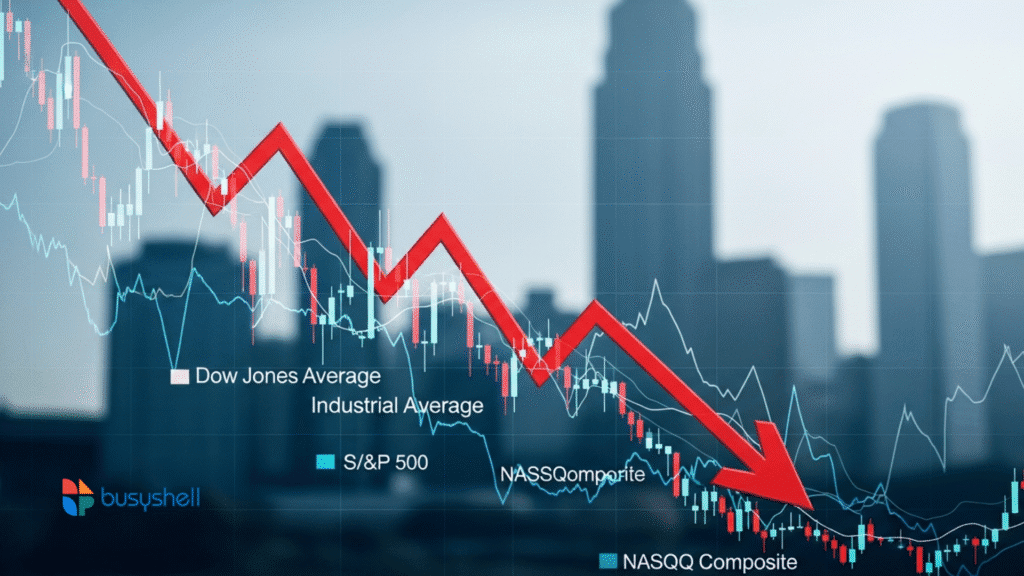
On the trading session in question, the major U.S. equity indices experienced a sharp reversal. The Dow Jones Industrial Average (“Dow”) fell 0.84%, the S&P 500 (“S&P 500”) dropped 1.56%, and the Nasdaq Composite (“Nasdaq”) slid 2.15%. (Sources: Investing.com, Trading Economics)
Notably, the market had initially rallied — the Nasdaq had been up as much as 2.6% intraday. But the gains were wiped out and reversed, leading to a steep descent by the close. (Source: The Business Times)
The retreat underscores how fragile current market sentiment is, especially in tech-heavy segments, and highlights several key themes important for investors.
Key Drivers Behind the Slide
1. Tech & AI Valuation Concerns
The stock of Nvidia Corporation (“Nvidia”) illustrates much of the day’s story: it surged by as much as 5% earlier in the session following strong earnings, but ended the day down about 3.1%. (Source: Yahoo Finance)
While the earnings beat was significant, the market interpreted it through a broader lens: concerns over steep valuations in the tech and artificial-intelligence (AI) space. Many investors are asking whether the rally in growth/AI names has become overheated. (Source: The Business Times)
Semiconductor and chip-related firms were hit hard. The semiconductor index fell ~4.8% on the day. (Source: Investing.com)
2. Economic Data and Monetary Policy Uncertainties
Alongside tech concerns, labour-market data added further uncertainty. Job-growth numbers were strong, yet the unemployment rate ticked up — creating a mixed signal for the Federal Reserve (Fed). (Source: The Business Times)
Because monetary policy heavily influences equity valuations (especially for growth stocks), any indication that the Fed may delay interest-rate cuts tends to spook investors. The market’s “fear gauge” — the Cboe Volatility Index (VIX) — closed at its highest level since April. (Source: Investing.com)
3. Intraday Volatility & Technical Breakdown
The intraday swing was dramatic: at one point, the Dow, S&P 500 and Nasdaq each traded over 1,000 points from their highs to lows. The Nasdaq’s intraday range of about 4.9 percentage points was its largest since April this year. (Source: Finviz)
From a technical-analysis perspective, many growth- and tech-oriented stocks broke key support levels, causing stop-loss triggers and accelerating the downward movement.
What This Means for Investors — Insights by Busyshell
At Busyshell, we prioritise actionable, long-term investment thinking. Here’s what the market reversal means for various investor profiles.
Implication A: Growth / Tech-Heavy Portfolios
For investors heavily weighted in tech/AI stocks, this reversal is a wake-up call. While long-term themes (AI, cloud, semiconductors) remain strong, valuations are under pressure.
Nvidia’s performance shows that earnings beats may no longer be enough if macro risks overshadow momentum.
Prudent move: Reassess overexposure to mega-cap tech; consider trimming or hedging with defensives or value sectors.
Implication B: Broad Market / Index Investors
The declines in the S&P 500 and Dow confirm this is more than a tech-specific issue — sentiment is weakening market-wide.
Investors expecting a smooth uptrend must now price in higher volatility.
Long-term investors should stay disciplined but recognize that the recent “euphoria phase” may be ending.
Implication C: Value / Defensive-Oriented Allocations
As growth struggles, value and defensive sectors may benefit. On the session, consumer staples was the only S&P sector to finish in positive territory. (Source: The Business Times)
This rotation suggests investors are seeking stability — often a precursor to broader consolidation.
Consider expanding exposure to high-quality dividend payers, utilities, real estate (depending on rates), and international diversification.
Implication D: Risk & Strategy Management
Large intraday swings highlight the importance of:
- Stop-loss discipline
- Proper hedging
- Balanced diversification
- Liquidity planning
As the Fed meeting approaches, be prepared for “data-driven shocks” — unexpected moves from labour reports, CPI, PPI or earnings guidance.
Broader Themes to Watch
Below are three major themes investors should monitor in the coming weeks.
Theme 1: AI, Semiconductors & the Tech Bubble Question
The AI-led boom is still strong, but expectations may now be fully priced in.
Nvidia beat earnings yet fell sharply, indicating markets want proof of sustainable growth, not just hype.
Investors must distinguish between:
- Companies with durable, structural demand (AI infra, cloud software)
- Companies priced for perfection, vulnerable to rotation
Theme 2: Interest Rates, Fed Timing & Economic Data
Markets are extremely sensitive to economic reports.
Despite strong job additions, the rising unemployment rate muddied the outlook for Fed rate cuts. (Source: The Business Times)
Fewer or delayed cuts could continue putting pressure on growth-stock valuations, while supporting value and defensive plays.
Theme 3: Rotation, Sentiment & Market Structure
The dramatic reversal signals deeper issues:
- Overcrowded growth trades can unwind rapidly
- Narrow leadership among a few mega-caps increases fragility
- Breaking technical levels triggers algorithmic selling
This is not a normal dip — it’s a sentiment shift.
Looking Ahead — What to Monitor in Stock Market the Next Weeks
✔ Earnings trends in major growth stocks
Are companies beating expectations and raising guidance?
✔ Labour and inflation data
Unexpectedly hot inflation could extend tech weakness.
✔ Valuation shifts
Are forward price-to-earnings multiples compressing?
✔ Sector rotation
Is leadership moving toward financials, industrials, energy, staples?
✔ Global macro and interest-rate risks
Watch semiconductor supply chains, U.S.–China relations, and central bank decisions.
Strategic Recommendations for Busyshell’s Audience
1. Re-evaluate risk exposure
Trim overweight positions in mega-cap tech if conviction is low. Add diversification.
2. Strengthen portfolio resilience
Maintain cash buffers. Use hedges carefully (inverse ETFs, options).
3. Focus on fundamentals
Look beyond the AI hype. Prioritize profitability, margins, guidance and execution.
4. Stay disciplined but flexible
Rebalance periodically. Avoid emotional decision-making.
5. Monitor economic and Fed signals closely
Markets are in a data-driven phase. Be vigilant.
Final Thoughts
The trading session — where the Dow, S&P 500 and Nasdaq reversed sharply from early gains — demonstrates how quickly sentiment can shift. The narrative has moved from “tech will keep rallying” to “which companies can justify high valuations amid macro uncertainty?”
While innovation remains strong, valuations, interest rates and market structure matter more than ever.
By staying alert to earnings, economic data and valuation pressures — and maintaining disciplined risk management — investors can position themselves to navigate volatility and seize new opportunities.
This commentary is brought to you by Busyshell — helping investors make smarter, data-driven decisions.
Disclaimer:
This article is created for informational and educational purposes only on behalf of Busyshell. It should not be considered financial, investment, or trading advice. Market conditions are dynamic and subject to change. Always conduct your own research or consult a certified financial advisor before making investment decisions. Busyshell and its authors are not liable for any financial losses or decisions made based on the content provided in this article. Past performance is not indicative of future results.