
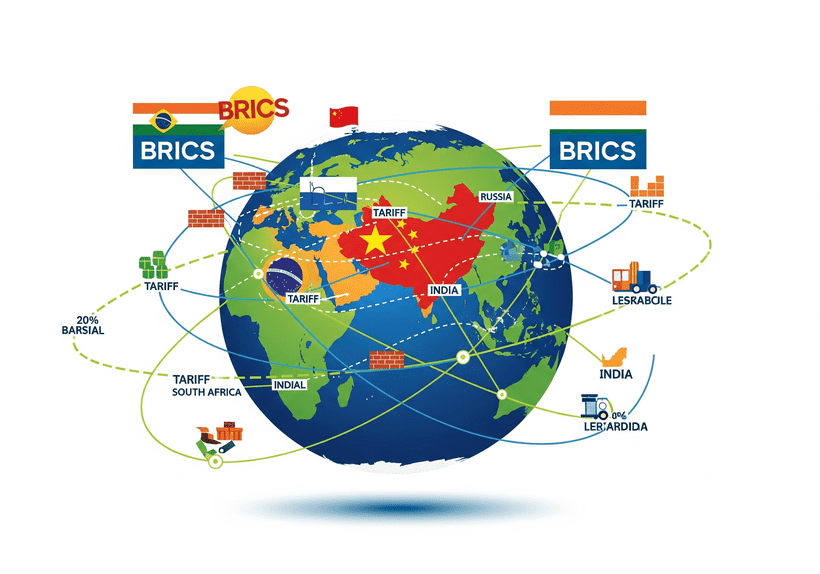
The global economy is undergoing rapid shifts, and the role of multilateral blocs like BRICS has become more crucial than ever. The BRICS nations on tariffs have taken a strong collective stance against rising protectionism, warning that trade restrictions could destabilize global supply chains and harm developing economies.
As the group looks to expand and strengthen its influence, India’s upcoming BRICS Chairship in 2026 is already being discussed with an agenda focusing on food and energy security, sustainable development, and digital innovation.
This comprehensive article dives deep into the BRICS nations’ concerns over tariffs, their stance on protectionism, the role of India’s leadership, and the broader financial implications for global and Indian investors.
BRICS Nations on Tariffs: The Context
Tariffs have historically been a tool for countries to protect domestic industries. However, in recent years, their aggressive use has sparked trade tensions worldwide.
- United States vs. China Trade War: Heavy tariffs imposed by both sides disrupted global trade flows between 2018–2020.
- Post-Ukraine Conflict Sanctions: Western sanctions on Russia triggered supply chain bottlenecks, particularly in energy and commodities.
- Emerging Economies’ Struggles: Many developing nations face higher costs and limited market access due to restrictive trade policies.
The BRICS nations on tariffs argue that unilateral protectionist actions undermine the global trading system. By voicing these concerns collectively, the bloc aims to position itself as a defender of free and fair trade, especially for the Global South.
👉 Similar to how investors weigh costs like the Importance of Expense Ratio in Mutual Fund Returns, countries evaluate trade tariffs as costs that directly reduce competitiveness and long-term growth potential.
Joint Communiqué: BRICS Nations on Tariffs and Protectionism
At the sidelines of the 80th UN General Assembly, BRICS Foreign Ministers issued a joint statement condemning the proliferation of trade-restrictive measures. The communiqué stressed:
- Multilateralism must be preserved to ensure fairness in global trade.
- Global South countries risk being marginalized due to unilateral tariff decisions by developed economies.
- Trade barriers threaten post-pandemic recovery, delaying global growth prospects.
This unified declaration is a continuation of BRICS’ long-standing demand for inclusive globalization, where emerging markets have equal opportunities.
India’s Priorities for the 2026 BRICS Chairship
India will take over the BRICS Chairship in 2026, and its agenda was outlined during the meeting by External Affairs Minister S. Jaishankar. Key focus areas include:
1. Food and Energy Security
India plans to push policies that safeguard global food supply chains and ensure affordable energy access for developing countries.
2. Climate Change and Sustainable Development
Building consensus on green energy and sustainable infrastructure will be high on India’s agenda.
3. Digital Transformation and Innovation
Leveraging India’s success in digital governance and fintech, the focus will be on promoting digital solutions to boost trade and inclusion.
👉 For individual investors, India’s emphasis on sustainability mirrors the strategy of diversifying portfolios through long-term options like Mutual Fund vs Fixed Deposit – Which is Better for Investors?.
BRICS Nations on Tariffs and UN Reform
Another significant issue raised alongside tariffs was the reform of the United Nations system, especially the Security Council.
- BRICS members reiterated support for India and Brazil’s aspirations for permanent seats.
- The ministers emphasized the need for greater representation of developing nations in global decision-making.
- A stronger UN presence from BRICS could reshape geopolitical power balances.
Much like an IPO reshapes corporate access to capital—explained in What is IPO? A Beginner’s Guide—UN Reform Would Redefine Global Governance Structures.
Geopolitical Unity: BRICS on Terrorism
The ministers reaffirmed their zero-tolerance stance against terrorism. They condemned terrorist acts in all forms, underscoring their unified commitment to peace and stability.
This collective voice boosts BRICS’ credibility as not just an economic bloc but also a political coalition capable of shaping global security dialogues.
Expanding Membership: Palestine’s Application
The BRICS bloc is expanding rapidly, with Palestine recently submitting its formal application to join. This move reflects the bloc’s attractiveness for nations seeking alternatives to Western-dominated financial and political institutions.
- Membership expansion increases BRICS’ influence in the Middle East.
- It boosts its reputation as a platform for the Global South’s collective voice.
- Palestine’s entry, if approved, will mark a historic moment for the bloc’s inclusivity.
BRICS Nations on Tariffs: Financial Implications
The BRICS’ financial arm, the New Development Bank (NDB), is making strides in diversifying funding mechanisms. Its recent announcement of a rupee-denominated bond issuance signals multiple objectives:
- De-dollarization: Reducing dependence on U.S. dollar funding.
- Local Currency Strengthening: Encouraging domestic financial markets.
- Infrastructure Financing: Channeling funds into long-term sustainable projects in India.
For Indian investors, this provides exposure to a new class of debt instruments. It’s comparable to choosing between SIP Investment Plans and bonds—covered in our guide on Best SIP Investment Plans in India.
Historical Perspective: BRICS Nations on Tariffs
The BRICS stance on tariffs isn’t new. Historically, the bloc has:
- 2009 (First BRICS Summit): Advocated for greater voice in global financial institutions.
- 2014 (Fortaleza Declaration): Called for reforms in the IMF and World Bank structures.
- 2022 (After Ukraine Conflict): Opposed unilateral sanctions impacting global energy flows.
Each stage demonstrates BRICS’ consistency in challenging policies they see as biased against emerging economies.
The Future Outlook for BRICS Nations on Tariffs
Looking ahead, the BRICS group is expected to:
- Push for tariff-free trade agreements among members.
- Expand the role of the NDB as a credible alternative to Western financial institutions.
- Promote local currency usage in cross-border trade.
- Shape commodity pricing policies for oil, gas, and food supplies.
For investors, this could lead to increased stability in emerging markets, making them attractive for long-term investments. Much like choosing between IPO, FPO, and Rights Issue—explained in Difference Between IPO, FPO, and Rights Issue Explained—investors will have to carefully assess risk versus opportunity in BRICS markets.
Conclusion
The concerns of the BRICS nations on tariffs mark a significant development in global economic governance. By standing together against protectionism, pushing for UN reform, and promoting financial independence, BRICS is carving out a stronger role for itself in shaping the future of global trade.
India’s upcoming 2026 Chairship is expected to further solidify this momentum, with its emphasis on sustainability, food security, and digital transformation. The bloc’s expansion and financial initiatives like the rupee bond issuance underline its ambition to become a credible counterbalance to Western-led institutions.
For investors, this means monitoring BRICS developments closely, as policy shifts could directly affect trade, energy markets, and investment opportunities.
Explore more insightful guides:
📝 Our Role as a Mutual Fund Distributor
We are a registered mutual fund distributor, committed to guiding investors in making informed financial decisions. While we provide insights into global events like the BRICS nations on tariffs, our expertise lies in helping clients build strong investment portfolios through mutual funds and SIPs.
📌 Disclaimer
The insights on BRICS nations on tariffs shared here are for informational purposes only and do not constitute investment or financial advice. Market conditions may change rapidly due to geopolitical or economic factors. Please consult a certified financial advisor before making any investment decisions.
FAQs on BRICS Nations on Tariffs
Q1. Why are BRICS nations against rising tariffs?
Because tariffs disrupt supply chains and marginalize developing economies.
Q2. What are India’s key priorities for the 2026 Chairship?
Food security, energy access, climate change, and digital innovation.
Q3. How is the New Development Bank supporting India?
By issuing rupee-denominated bonds to fund infrastructure and green projects.
Q4. What does Palestine’s application mean for BRICS?
It highlights the bloc’s growing appeal as an inclusive global platform.
Q5. Will BRICS tariffs stance impact global markets?
Yes, reduced dependence on dollar-based systems could alter global capital flows.