
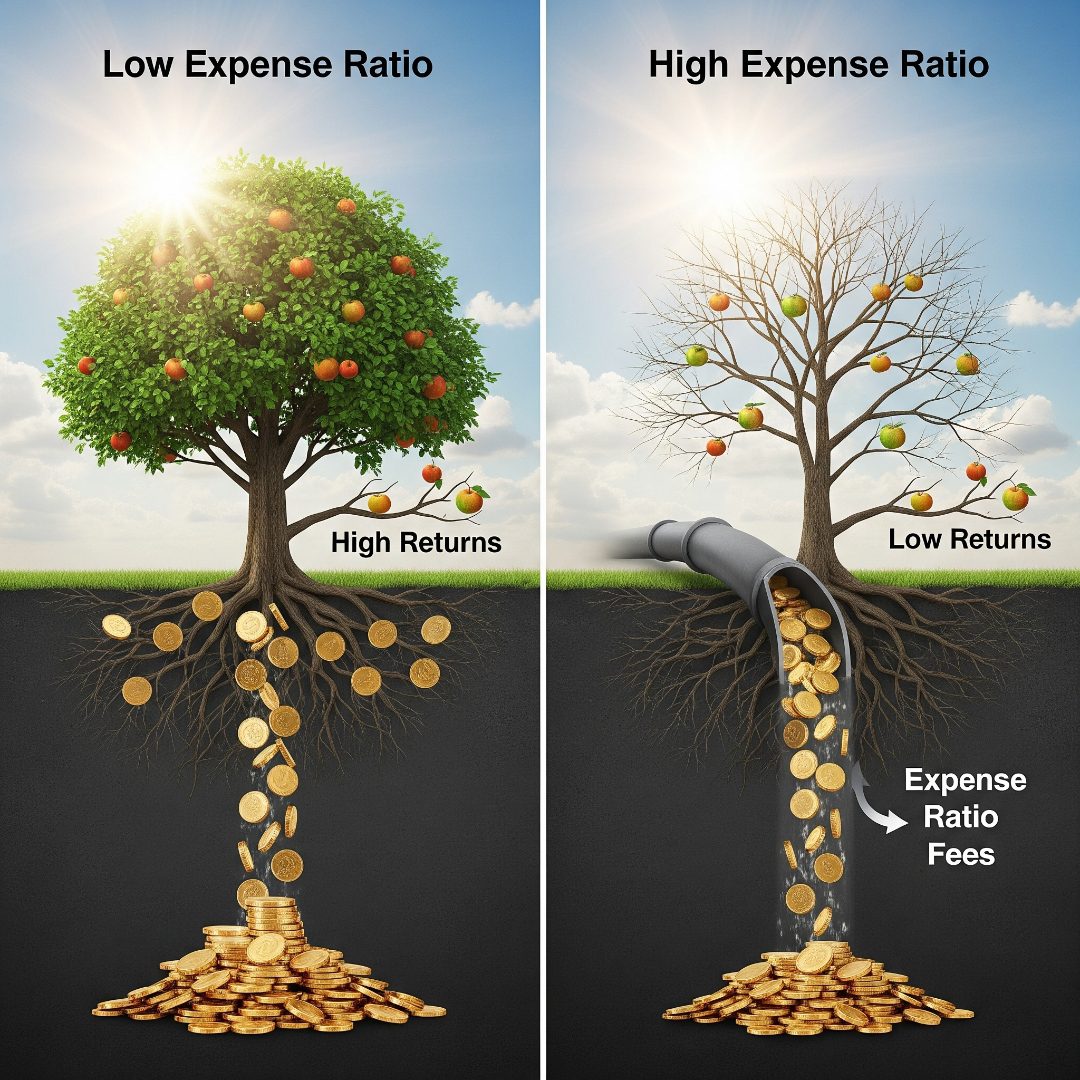
When choosing a mutual fund, investors often look at past performance, fund manager reputation, and investment style. However, one factor that silently impacts your returns year after year is the Expense Ratio in Mutual Funds.
This article will explain the importance of expense ratio, how it is calculated, its impact on long-term wealth, and why selecting low expense ratio mutual funds can make a significant difference.
What is Expense Ratio in Mutual Funds?
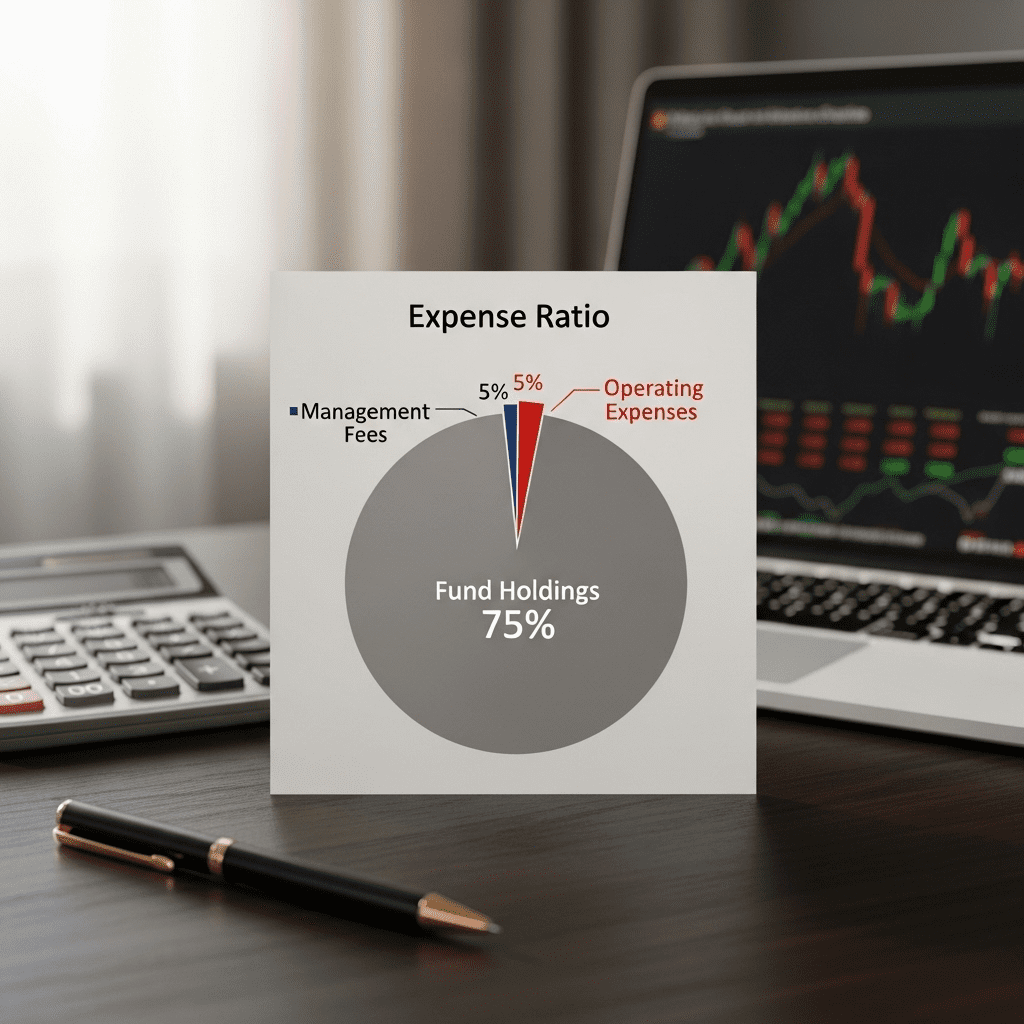
The Expense Ratio in Mutual Funds represents the annual fee charged by the Asset Management Company (AMC) to manage your investment. This fee is expressed as a percentage of the fund’s average assets under management (AUM).
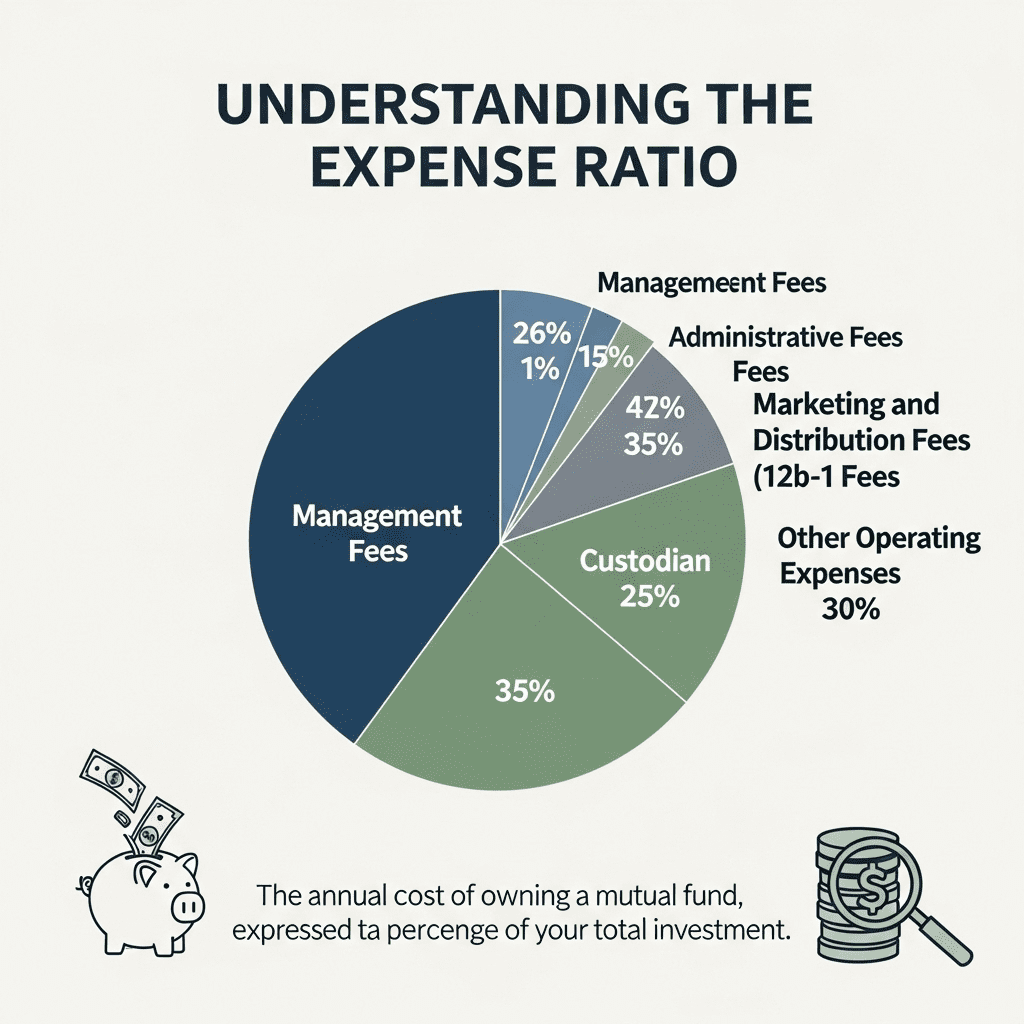
Expense Ratio Meaning in Mutual Funds includes:
- Fund management fees (paid to fund managers)
- Administrative costs
- Marketing and distribution charges
- Registrar and transfer agent fees
In simple terms, the Expense Ratio = Total Fund Expenses ÷ Average AUM.
Importance of Expense Ratio
The importance of expense ratio lies in its direct impact on investor returns. Even a small difference of 0.5%–1% in expense ratio can make a huge difference over 10–15 years due to compounding.
For example:
- Fund A with an expense ratio of 1.5%
- Fund B with an expense ratio of 0.8%
If both funds generate 12% gross returns, Fund B will deliver higher net returns because it charges less.
Impact of Expense Ratio on Returns
The impact of expense ratio on returns is often underestimated. High expense ratios eat into your profits, reducing long-term wealth creation.
- Higher expense ratio → Lower net returns
- Lower expense ratio → Higher compounding effect
For long-term investors, expense ratio and long-term returns are closely linked. Over decades, even a 1% difference can cost lakhs of rupees.
Mutual Fund Expense Ratio Explained
Let’s break down Mutual Fund Expense Ratio Explained with an example:
- Suppose you invest ₹10,00,000 in a fund with an expense ratio of 1.5%.
- The AMC deducts ₹15,000 annually as management costs.
- If the fund earns 12% gross return, your net return reduces to 10.5%.
Thus, while the difference seems small, it compounds over time and reduces your final corpus.
Expense Ratio Calculation in Mutual Funds
The expense ratio calculation in mutual funds is:
Expense Ratio = (Total Operating Expenses ÷ Average AUM) × 100
For instance, if a mutual fund has ₹500 crore AUM and spends ₹5 crore on operating costs, its expense ratio is 1%.
Direct Plan vs Regular Plan Expense Ratio
One of the most important comparisons is Direct Plan vs Regular Plan Expense Ratio.
- Direct Plans: Lower expense ratios since no distributor commission is included.
- Regular Plans: Higher expense ratios due to commissions.
Example:
- Direct Plan Expense Ratio = 0.8%
- Regular Plan Expense Ratio = 1.5%
Over 10 years, the direct plan can provide significantly higher returns.
Hidden Charges in Mutual Funds
Some investors worry about hidden charges in mutual funds. The truth is, SEBI regulates expenses and requires AMCs to disclose them transparently in the fund fact sheet.
Still, higher expense ratios in regular plans often act like hidden costs when compared to direct plans.
Expense Ratio vs Returns
When comparing expense ratio vs returns, remember that a lower expense ratio does not guarantee higher performance. However, it ensures more of your returns stay with you.
Thus, while choosing mutual funds, evaluate both performance consistency and low expense ratio.
Importance of Low Expense Ratio
The importance of low expense ratio cannot be overstated for long-term investors. By reducing costs, you maximize compounding benefits.
- Low expense ratio mutual funds = Higher long-term wealth
- High expense ratio = Reduced compounding
Best Mutual Funds with Low Expense Ratio
Investors often search for the best mutual funds with low expense ratio. Typically, index funds and ETFs have the lowest expense ratios (0.1%–0.3%).
Actively managed funds generally have higher expense ratios (1%–2.5%) but may justify the cost if they consistently outperform.
Mutual Fund Charges and Expense Ratio
While exploring mutual fund charges and expense ratio, remember that this is the main ongoing cost. Entry and exit loads may apply in some funds, but SEBI has capped overall expenses to protect investors.
How Expense Ratio Affects Returns in Long-Term Investing
The real impact of expense ratio on long-term returns is massive. Let’s consider two funds:
- Fund X: 12% returns, 2% expense ratio → Net = 10%
- Fund Y: 12% returns, 0.5% expense ratio → Net = 11.5%
On a ₹10 lakh investment over 20 years:
- Fund X grows to ~₹67 lakh
- Fund Y grows to ~₹86 lakh
That’s a difference of nearly ₹19 lakh – all due to expense ratio.
- Mutual Fund vs Fixed Deposit – Which is Better?
- What is IPO? A Beginner’s Guide to Initial Public Offerings in brief
- Step-by-Step Guide: How to Start SIP
- Difference Between IPO, FPO, and Rights Issue Explained
📌 FAQs on Expense Ratio in Mutual Funds
Q1. What is the expense ratio in mutual funds?
The expense ratio in mutual funds is the annual fee charged by the AMC to manage your investments, covering fund management, administration, and distribution costs.
Q2. Why is the expense ratio important?
The importance of expense ratio lies in its impact on your net returns. A lower expense ratio means more of your money stays invested, boosting compounding.
Q3. How does the expense ratio affect returns?
A higher expense ratio reduces your net returns. Over long periods, this can significantly lower your final corpus.
Q4. Which is better: direct plan or regular plan in terms of expense ratio?
Direct plans have a lower expense ratio than regular plans since they exclude distributor commissions, making them more cost-efficient.
Q5. What are the best mutual funds with low expense ratio?
Typically, index funds and ETFs have the lowest expense ratios. Some direct equity mutual funds also offer low-cost options.
Disclaimer
The information provided in this article is for educational and informational purposes only. Mutual fund investments are subject to market risks, and past performance does not guarantee future returns. Investors should carefully review all scheme-related documents, including the expense ratio and other charges, before investing. It is recommended to consult with a certified financial advisor to determine the suitability of mutual funds for your financial goals.