
On October 29-30, 2025 the U.S. Federal Reserve (Fed) announced its second straight interest‐rate cut of the year, lowering the target range by 25 basis points (bps) to 3.75%–4.00%. This decision has major implications for both global and Indian markets.
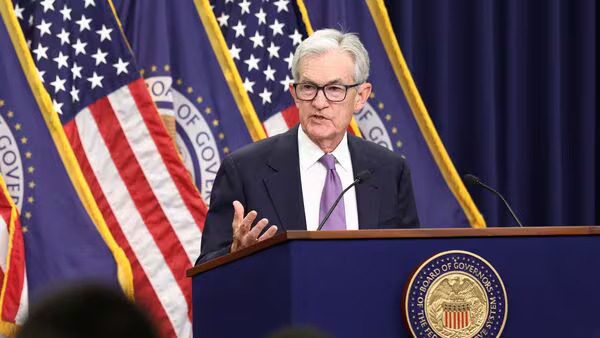
Key Highlights of US Fed Policy October 2025
- Fed Rate Cut: 25 basis points reduction
- New Rate Range: 3.75%–4%
- Second Consecutive Cut: Following previous rate reduction
- December Outlook: Powell doubts another cut
- Inflation Concerns: Trump tariffs pushing inflation higher
- Asset Purchases: Fed to end asset purchases by December 1, 2025
- Labor Market: Rising risks in employment sector
Fed Policy Highlights & Why It Matters
• The cut reflects growing concern over softening in the labour market, even as inflation remains above the Fed’s 2% target.
• Fed Chair Jerome Powell noted that a December rate‐cut is “not a foregone conclusion”, signalling caution.
• The Fed also confirmed it will end asset-purchase reductions by December 1, as part of its balance-sheet normalisation.
• The Fed flagged that tariffs imposed under Donald Trump’s administration are contributing to inflation, strengthening its reluctance to ease too rapidly.
Global Market Reaction: US & Beyond
In the U.S., markets were mixed: the Dow Jones Industrial Average dipped ~0.16%, the S&P 500 held flat, while the Nasdaq Composite posted a +0.55% gain. The Russell 2000 slid −0.87%. Your given statistics reflect this pressure.
Risk assets are cautious because although easing has arrived, the Fed’s message is not unequivocally dovish. A stronger dollar and higher U.S. bond yields also weigh.
Indian Market Lens: The Nifty, Rupee & FPIs
In India, the futures indicator (GIFT Nifty) was down ~84 pts, reflecting investor caution despite the rate-cut backdrop.
Domestic investors must watch how foreign portfolio investors (FPIs) respond: a cautious Fed may reduce risk appetite for emerging markets.
With tariffs and inflation spilling globally, India’s export sector and rupee could see volatility.
Importantly, the cut in the U.S. could relieve some global funding pressure, but the overall impact depends on global & domestic growth prospects.
Key Risks Ahead: Tariffs, Labour Market and Inflation
• Tariffs: U.S. tariff measures are pushing up goods inflation globally. The Fed explicitly linked a chunk of inflationary pressure to tariffs.
• Labour market: Weakening U.S. labour data means less headroom for the Fed. Uncertainty due to the U.S. federal government shutdown complicates the picture.
• India linkage: A global slowdown could hit Indian IT & export sectors; rising U.S. yields may lead to rupee pressure.
What Investors Should Watch
- U.S. inflation data (CPI/PCE) and unemployment claims
- Fed Chair Powell’s next press conference & forward guidance
- India’s macro indicators: rupee move, FPI flows, export data
- Corporate earnings in the U.S. and India given rate-cut context
- Tariff/trade-deal developments, including any meeting between Trump & China’s President Xi Jinping
US Fed Rate Cut: Global Market Reaction
Global equities reacted mixed after the Fed’s move.
- Dow Jones −0.16%, S&P 500 flat, Nasdaq +0.55%, while Russell 2000 −0.87%.
- Investors are uncertain because Powell’s tone sounded “cautious”, suggesting the Fed is not in a rush to ease further.
- Alphabet shares jumped +6.73%, while Meta (−7.37%) and Microsoft (−3.98%) slipped after earnings.
Energy and commodity markets also shifted:
Gold rebounded +0.5% to $3951/oz after four days of declines
Brent Crude −1.4% to $64.1/bbl
US Fed Rate Cut: After-Hours Earnings Results
Tech giants reported their quarterly earnings with dramatic after-hours movements:
Apple & Amazon: Earnings released today
Alphabet (Google): Surged 6.73% after strong earnings
Meta (Facebook): Dropped 7.37% on disappointing guidance
Microsoft: Fell 3.98% below expectations
Nvidia: Hit historic $5 trillion market cap, up 2.99%
Understanding IPO Lot Size, Price Band, and Allotment Process
What is IPO? A Beginner’s Guide to Initial Public Offerings in brief
Gold ETF vs Physical Gold – Which is the Smarter Investment?
Disclaimer
The information in this article is for informational purposes only, and does not constitute financial or investment advice. Investors should consult their own financial advisor before making any investment decisions.
FAQs
Q1: Does the Fed rate cut mean Indian interest rates will fall?
A1: Not necessarily. While a U.S. cut can relieve global funding cost pressure, India’s domestic rate decisions depend on inflation, fiscal policy and local growth.
Q2: Should I buy Indian equities now given the Fed action?
A2: The cut is a supportive factor, but take into account broader global risks, domestic fundamentals and market valuations.
Q3: How do tariffs affect Indian markets?
A3: Tariffs raise inflation globally, reduce global trade growth, and can hurt India’s export-dependent sectors and currency.