
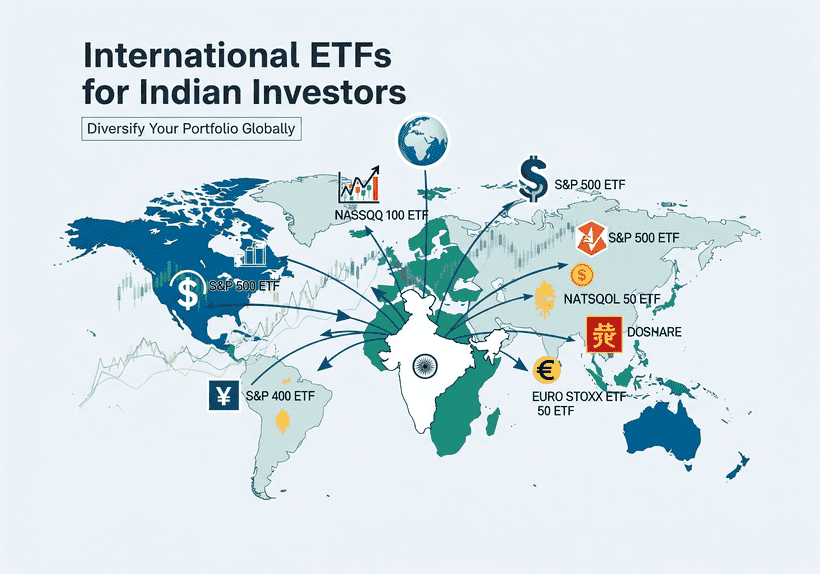
International ETFs have emerged as one of the most accessible investment vehicles for Indian investors seeking global portfolio diversification without the complexities of direct overseas investing. With the Indian equity markets showing remarkable growth, savvy investors are increasingly looking toward International ETFs to reduce geographical concentration risk and tap into global growth opportunities. 🌎💹
Read more about ETF here -> What is ETFs?
Understanding International ETFs 📘🌍
International ETFs are exchange-traded funds that provide Indian investors exposure to foreign markets, international indices, and global companies through a single investment instrument. These funds track international benchmarks such as the NASDAQ 100, S&P 500, or emerging market indices, allowing domestic investors to participate in global economic growth without directly purchasing foreign securities. 🌐📈
Unlike traditional mutual funds, International ETFs trade on Indian stock exchanges like NSE and BSE, offering real-time liquidity and transparent pricing. The primary advantage lies in their ability to provide instant geographical diversification, reducing dependency on Indian market performance alone. 💹🔄
How International ETFs Function ⚙️📊
International ETFs operate by either directly holding foreign securities or investing in overseas ETFs as underlying assets. Fund managers passively track international indices, maintaining lower expense ratios compared to actively managed international funds. The ETF units can be bought and sold during market hours, providing flexibility similar to individual stock trading. 🕒💼
Regulatory Framework and Investment Limits 🛡️📜
SEBI Guidelines for International ETFs 🏛️✅

The Securities and Exchange Board of India (SEBI) has established specific regulations governing International ETFs to protect investor interests while facilitating global diversification. Under current SEBI guidelines, mutual funds can make overseas investments up to USD 1 billion per fund house, with an overall industry limit of USD 7 billion. 🌍💵
For International ETFs specifically, SEBI has set a limit of USD 300 million per mutual fund within the overall industry cap of USD 1 billion. These restrictions have periodically led to suspension of fresh inflows when limits are reached, particularly during periods of strong market performance. 🚦📉
Current Status of International ETF Investments 📣⏸️
As of 2024-2025, several International ETFs have temporarily halted fresh investments due to reaching SEBI-prescribed limits. However, existing investors can continue trading these ETFs on exchanges, and new inflows may resume as markets correct or limits are revised. 🔁📈
Investment Routes for Indian Investors 🧭🇮🇳
Liberalised Remittance Scheme (LRS) 💱✈️
Indian residents can invest in International ETFs through the Liberalised Remittance Scheme, which permits remittances up to USD 250,000 per financial year for investment purposes. This limit covers all overseas investments including direct foreign stock purchases, international mutual funds, and global ETFs. 💵🌐
Under LRS regulations updated in 2025, no Tax Collected at Source (TCS) applies on the first ₹10 lakh of annual remittances. Beyond this threshold, TCS rates vary based on purpose – 20% for general investment purposes, 5% for education, and nil for education loans. 🧾⚖️
Domestic International ETFs 🏦📈
The more accessible route involves investing in International ETFs listed on Indian exchanges. These funds provide foreign exposure while maintaining rupee-denominated investments, eliminating currency conversion complexities for retail investors. 🪙🇮🇳
Popular International ETFs in India 🌟📊
Top Performing International ETFs 🏅🚀
Several International ETFs have gained popularity among Indian investors for their strong performance and global diversification benefits : 🌍💼
Motilal Oswal NASDAQ 100 ETF – This fund provides exposure to top US technology companies, delivering impressive returns of 34.1% in one year and 23.6% over five years as of January 2025. 🇺🇸💻
Mirae Asset NYSE FANG+ ETF – Focusing on leading technology and internet companies, this ETF offers concentrated exposure to high-growth US stocks. 📱📈
Nippon Hang Seng ETF – Provides access to Hong Kong markets and Chinese companies listed on the Hong Kong Stock Exchange. 🇭🇰🏙️
Sector-Specific International ETFs 🧩🧪
International ETFs also offer sector-specific exposure, allowing investors to target particular themes or industries globally. These thematic ETFs focus on technology, healthcare, consumer discretionary, or other sectors across international markets. 🧠🩺
Taxation of International ETFs 🧾⚖️
Capital Gains Tax Structure 📉📅
The taxation of International ETFs depends on the investment structure and holding period. For units purchased after April 1, 2023, new tax rules apply from April 1, 2025 : 🗓️🔍
Long-Term Capital Gains (LTCG) – For holdings exceeding 24 months, gains are taxed at 12.5% without indexation benefits. This applies to direct investments in foreign securities or international mutual funds. 📈🧮
Short-Term Capital Gains (STCG) – Holdings under 24 months are taxed according to individual income tax slab rates. 🧾🧱
Special Considerations for Domestic International ETFs 🏦📝
International ETFs listed on Indian exchanges follow different tax treatment. For these funds, the differentiation between short-term and long-term gains occurs at 12 months, with LTCG taxed at 12.5% and STCG at slab rates. ⏱️✅
Foreign Asset Declaration 🌐🗂️
Investors holding International ETFs listed on Indian exchanges don’t need to declare them separately as foreign assets in their Income Tax Returns. However, direct investments in overseas ETFs require disclosure under the foreign assets section. 🧾📤
Advantages of International ETFs 🎯🌍
Portfolio Diversification Benefits 🧺🔄
International ETFs provide crucial geographical diversification, reducing portfolio concentration risk in Indian markets. This diversification becomes particularly valuable during periods of domestic market volatility or economic uncertainty. 🌪️🛡️
By investing in International ETFs, investors gain exposure to different economic cycles, currencies, and market dynamics. This global spread helps stabilize portfolio returns during regional market downturns. 🌎⚖️
Access to Global Growth Stories 🚀🌐
International ETFs enable participation in global growth themes unavailable in Indian markets. Investors can access leading technology companies, innovative healthcare firms, or emerging market opportunities through these funds. 💡🧬
The ability to invest in world-class companies like Apple, Microsoft, Amazon, or Tesla through International ETFs provides exposure to global innovation and market leadership. 🌟💻
Cost-Effective Global Investing 💰✅
Compared to direct overseas investing, International ETFs offer a cost-effective solution for global diversification. Lower expense ratios, reduced transaction costs, and elimination of individual stock research requirements make these funds attractive for retail investors. 🧮💵
Liquidity and Transparency 💧🔍
International ETFs listed on Indian exchanges provide daily liquidity and transparent pricing. Real-time NAV updates and exchange trading enable quick entry and exit decisions based on market conditions. ⏱️📊
Risks and Considerations ⚠️🧠
Currency Risk 💱🌊
International ETFs expose investors to currency fluctuations between the Indian rupee and foreign currencies. While this can provide additional returns during rupee weakness, it can also reduce gains during rupee strength. 📉📈
Regulatory Changes 🏛️🔄
SEBI regulations governing International ETFs can change, potentially affecting investment flows or fund operations. Investors should stay informed about regulatory updates that might impact their investments. 📰🧭
Market Risk 📉🌐
International ETFs carry inherent market risks of the underlying foreign markets. Economic downturns, political instability, or market corrections in target countries directly affect ETF performance. 🌪️📉
Limited Fresh Investment Opportunities 🚫🧳
Current SEBI limits have led to suspension of fresh investments in several popular International ETFs. This constraint may limit investment options during certain market conditions. 🕰️🔒
Investment Strategy and Portfolio Allocation 🧭🗂️
Optimal Allocation Percentage 📐🎯

Financial experts generally recommend allocating 10-20% of investment portfolio to international assets for optimal diversification. This allocation provides meaningful global exposure while maintaining primary focus on domestic growth opportunities. 🌍📈
Systematic Investment Approach 🗓️🤝
Investors can adopt systematic investment plans (SIPs) in International ETFs to average out currency fluctuations and market volatility. Regular investments help capture long-term global growth trends while managing timing risks. 🔁📊
Rebalancing Strategies 🔄⚖️
Regular portfolio rebalancing between domestic and international allocations ensures maintained target exposure percentages. Annual or semi-annual rebalancing helps optimize risk-return profiles as market conditions evolve. 🧮🧭
How to Invest in International ETFs 🛠️📲
Through Mutual Fund Distributors 🤝🏦
As an AMFI-registered mutual fund distributor, Busyshell provides professional guidance for International ETF investments Busyshell AMFI Registration. Our expertise helps investors select appropriate International ETFs based on individual risk profiles and financial goals. 🎓📈
Direct Investment Process 🧾🖥️
Investors can purchase International ETFs through their existing demat accounts and trading platforms. The process involves selecting appropriate ETFs, placing buy orders during market hours, and monitoring performance through portfolio tracking tools. 🧮📊
Documentation Requirements 📂✅
International ETF investments through Indian exchanges require standard KYC documentation. For direct overseas investments under LRS, additional documentation including Form A2 and purpose codes may be necessary. 📝🌍
Future Outlook for International ETFs 🔮🌐
Regulatory Evolution 🏛️📈
SEBI continues evaluating International ETF regulations to balance investor access with prudential limits. Future regulatory changes may expand investment limits or introduce new product categories. 🧭🧩
Product Innovation 🧪🚀
Fund houses are developing innovative International ETF structures to provide enhanced global exposure while complying with regulatory constraints. These innovations may include currency-hedged variants or sector-specific international themes. 💡💱
Market Growth Prospects 📈🌍
Growing investor awareness about global diversification benefits is expected to drive International ETF demand. Rising disposable incomes and financial literacy support long-term growth in international investing. 🧠💼
Comparison: International ETFs vs Other Global Investment Options ⚖️📊
| Investment Option 🧾 | Minimum Investment 💸 | Liquidity 💧 | Currency Risk 💱 | Tax Treatment 🧾 | Complexity 🧠 |
|---|---|---|---|---|---|
| International ETFs (Domestic) | ₹500-1000 | High | Yes | LTCG 12.5% | Low |
| Direct Foreign Stocks | $100+ | Medium | Yes | LTCG 12.5% | High |
| International Mutual Funds | ₹500-1000 | Daily | Yes | LTCG 12.5% | Medium |
| Overseas ETFs (Direct) | $100+ | High | Yes | LTCG 12.5% | High |
Tax Planning with International ETFs 🧾🧠
Optimizing Tax Efficiency 🧮📅
Investors can optimize tax efficiency by timing International ETF transactions to qualify for long-term capital gains treatment. Holding periods exceeding 24 months (for international funds) or 12 months (for domestic international ETFs) enable preferential tax rates. ✅⏳
Loss Harvesting Opportunities 🍂📉
International ETFs provide tax loss harvesting opportunities to offset capital gains from other investments. Strategic selling of underperforming international positions can reduce overall tax liability while maintaining global exposure. 🔁🧾
Busyshell is an AMFI-registered mutual fund distributor. Please refer to our AMFI registration details for complete information about our services and credentials. ✅🏦
Frequently Asked Questions (FAQs) ❓📚
Q1: What is the minimum investment amount for International ETFs in India?
A: Most International ETFs listed on Indian exchanges require a minimum investment of ₹500-1000, equivalent to one ETF unit. The exact amount varies based on the ETF’s current market price. 💸📈
Q2: Can NRIs invest in International ETFs in India?
A: Yes, NRIs can invest in International ETFs listed on Indian exchanges through their NRE or NRO accounts, subject to FEMA regulations and RBI guidelines. 🌏🏦
Q3: How are dividends from International ETFs taxed in India?
A: Dividends from International ETFs are added to total taxable income and taxed according to individual income tax slab rates. 🧾💰
Q4: What happens if SEBI limits are reached for International ETFs?
A: When SEBI-prescribed limits are reached, fund houses suspend fresh investments in affected International ETFs. Existing investors can continue trading on exchanges, and fresh investments resume when limits are available. 🚦🔁
Q5: Do International ETFs provide better returns than domestic ETFs?
A: International ETF returns depend on global market performance and currency movements. While they may outperform during certain periods, they also carry additional currency and geopolitical risks compared to domestic ETFs. 🌍⚖️
Q6: Can I invest in International ETFs through SIP?
A: Yes, many brokers and mutual fund distributors offer SIP facilities for International ETFs, enabling systematic investment to average out market volatility and currency fluctuations. 🗓️🤝
Q7: What is the difference between International ETFs and International Mutual Funds?
A: International ETFs trade on exchanges with real-time pricing and higher liquidity, while International Mutual Funds are priced once daily and offer SIP facilities. Both provide similar global exposure with slightly different operational structures. 🕒📊
Q8: How do I track the performance of my International ETF investments?
A: International ETF performance can be tracked through broker platforms, ETF provider websites, or financial data platforms that provide real-time NAV updates and benchmark comparisons. 📈🖥️
Q9: Are International ETFs suitable for conservative investors?
A: International ETFs carry market and currency risks, making them more suitable for moderate to aggressive investors. Conservative investors should limit international allocation and focus on diversified global funds rather than sector-specific ETFs. 🧭🛡️
Q10: What documentation is required for International ETF investments?
A: For International ETFs listed in India, standard KYC documentation through your broker is sufficient. Direct overseas ETF investments under LRS require additional documentation including Form A2 and appropriate purpose codes. 📝📂
Disclaimer ⚠️📜
The information provided in this blog post is for educational and informational purposes only and should not be construed as investment advice. International ETF investments are subject to market risks, currency fluctuations, and regulatory changes. Past performance does not guarantee future results. 🛡️📉
Investors should carefully consider their financial objectives, risk tolerance, and investment horizon before making investment decisions. It is recommended to consult with qualified financial advisors or registered mutual fund distributors before investing in International ETFs. 🎓🧭
Tax implications may vary based on individual circumstances and applicable laws. Investors should consult tax professionals for personalized tax advice related to International ETF investments. 🧾👩💼
SEBI regulations and LRS limits are subject to change. Investors should verify current regulations before making investment decisions. 🏛️🔍