

The RBI Monetary Policy October 2025 marks the second consecutive pause in the repo rate after cumulative easing of 100 basis points earlier in the year. By holding the RBI monetary policy repo rate steady at 5.5% with a neutral stance, the RBI Monetary Policy Committee (MPC) is signaling cautious optimism about domestic growth while remaining vigilant on inflation and external risks.
Investors, borrowers, and financial analysts closely monitored the announcement, anticipating guidance on the future trajectory of the RBI monetary policy rate, liquidity management, and the interplay of domestic and global economic factors. This article provides a detailed overview of the RBI monetary policy October 2025, its implications, and what to watch in the coming months.
Headline Decisions in RBI Monetary Policy October 2025
The RBI Monetary Policy Committee decided to:
- Keep the repo rate unchanged at 5.5%
- Maintain a neutral stance, signaling no immediate rate cuts or hikes
- Reaffirm the Consumer Price Index (CPI) target of 4% ± 2%
Other key policy rates remain unchanged:
- Standing Deposit Facility (SDF): 5.25%
- Marginal Standing Facility (MSF) / Bank Rate: 5.75%
The committee emphasized calibrated liquidity management under the LAF corridor to maintain credit flow while ensuring inflation remains in check.
By keeping the RBI monetary policy repo rate steady, the central bank aims to assess the impact of GST rationalization, easing food inflation, and global tariff risks before making any further policy moves.
Inflation Outlook in RBI Monetary Policy
One of the critical elements influencing the RBI monetary policy committee’s decision was the inflation trajectory.
Key Takeaways on Inflation:
- FY26 CPI projection: 2.6%, lower than previous forecasts
- Drivers of easing: Rationalization of GST rates and moderation in food prices
- Policy implications: While lower inflation provides space for future rate cuts, the MPC has opted for caution rather than immediate easing
The RBI’s approach reflects a commitment to balancing growth and price stability. Despite inflation drifting lower, the RBI monetary policy repo rate has not been adjusted yet, signaling the MPC’s preference to monitor trends over a few months before acting.
Growth Outlook in RBI Monetary Policy October 2025
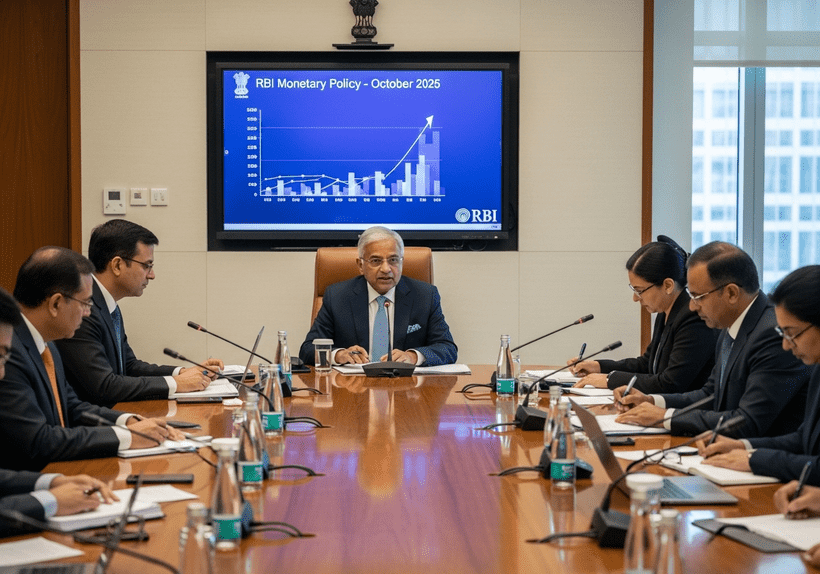
The RBI monetary policy committee raised its FY26 GDP growth projection to around 6.8%, citing robust domestic demand. Key factors influencing growth expectations include:
- Resilient consumption and investment demand
- Infrastructure and capital expenditure push by the government
- Stable credit growth
However, the MPC also highlighted external risks such as:
- Tariff-driven trade disruptions
- Export headwinds due to slowing global demand
- Currency volatility
By holding the RBI monetary policy repo rate, the committee ensures growth momentum is sustained without triggering inflationary pressures.
Why the RBI Monetary Policy Repo Rate Was Held
Despite lower inflation and ongoing transmission from previous cuts, several factors contributed to the RBI monetary policy committee’s decision to hold rates:
- Caution on GST Reforms: The MPC wants to see the full impact of GST rationalization on inflation and consumption before resuming easing.
- External Uncertainties: Rising tariffs and geopolitical risks could affect imports, exports, and overall inflation.
- Policy Transmission: Banks are still transmitting past 100 bps cuts to lending and deposit rates, and the MPC prefers to evaluate its effectiveness fully.
Economists were divided: some suggested a 25 bps rate cut could be warranted, but the consensus leaned toward holding the repo rate steady for now.
Liquidity Management and Transmission
The RBI monetary policy continues to emphasize calibrated liquidity support:
- Ensuring sufficient credit flow to sectors needing capital
- Monitoring banks’ transmission of past repo rate cuts to lending and deposit rates
- Adjusting short-term liquidity instruments under the LAF corridor as needed
This cautious approach allows the RBI monetary policy committee to maintain a neutral stance while remaining flexible to future macroeconomic developments.
Macro and Market Context
The RBI’s decision comes in the backdrop of multiple domestic and global developments:
- US Federal Reserve easing: Global interest rates have moderated, affecting capital flows to emerging markets
- India’s GST reforms: Reductions in indirect taxes have a disinflationary effect
- US tariffs on Indian goods: Tariff risks could affect exports, necessitating careful monitoring of external balances
Financial markets largely anticipated a pause. Observations post-policy announcement include:
- Stable bond yields
- Marginally firmer rupee
- Equity markets responding to improved growth guidance
Investors and analysts are using this window to gauge the MPC’s messaging on potential December actions.
Implications for Borrowers
With the RBI monetary policy repo rate on hold, borrowers can expect:
- EMI stability for loans linked to EBLR or MCLR
- Gradual transmission of previous cuts, particularly for new loans or variable-rate products
- Borrowers should monitor bank-specific rate adjustments and product-specific offerings
This policy provides a near-term steady borrowing cost environment for households and businesses.
Implications for Investors
For investors, the RBI monetary policy October 2025 suggests:
- Duration strategies in bonds should align with liquidity and inflation guidance
- Equity investors may benefit from upgraded GDP growth but must account for tariff risks
- Interest rate-sensitive sectors (banking, NBFCs, real estate) require careful positioning
Monitoring CPI prints, core inflation, credit growth, and liquidity conditions will be critical to anticipate potential RBI monetary policy rate cuts later in FY26.
Could a Rate Cut Still Come?

While the repo rate remains unchanged, a small probability of a 25 bps rate cut in December exists if:
- Inflation remains below 4%
- GST reforms do not trigger demand-pull pressures
- External risks stabilize
Analysts from Nomura, SBI Research, and Crisil suggest that December could be a deciding month for further easing, depending on domestic and global economic signals.
Key Watchpoints Post-Policy
Investors and market participants should track:
- Governor’s post-policy remarks and MPC minutes – For thresholds on any future RBI monetary policy repo rate moves
- CPI and core inflation prints – To assess inflation durability
- Bank credit growth – As a signal of policy transmission effectiveness
- Liquidity adjustments under LAF – Influencing short-term funding rates
- External developments – Tariffs, global interest rates, and currency movements
Staying updated on these factors will help participants anticipate future RBI monetary policy rate cuts or any tightening measures.
Conclusion
The RBI Monetary Policy October 2025 reinforces a cautious but growth-friendly stance. By holding the repo rate at 5.5% and maintaining a neutral approach, the RBI monetary policy committee is balancing domestic economic momentum with global uncertainties.
For borrowers, this provides near-term stability in loan repayments. For investors, the policy hints at a favorable growth environment while signaling careful monitoring of inflation and liquidity.
Looking ahead, the December MPC meeting will be crucial in determining whether residual easing is warranted, depending on domestic inflation and growth signals.
📝 Disclaimer
This article is for educational purposes only and does not constitute investment advice. Always assess your risk tolerance and consult a qualified financial advisor before making decisions related to the RBI monetary policy, India RBI monetary policy, RBI monetary policy repo rate, RBI monetary policy committee, or any anticipated RBI monetary policy rate cut.