
📈 Introduction: Why Every Investor Should Care About ROCE
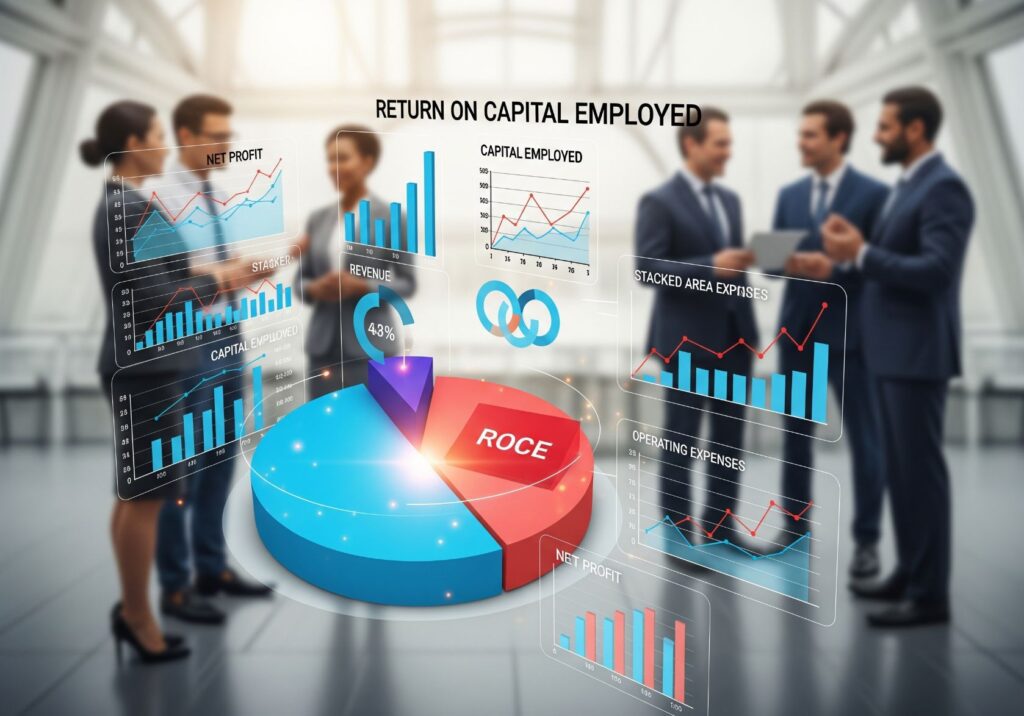
In the world of investing, profits tell only half the story. What truly matters is how efficiently a company uses its money to generate those profits. That’s where Return on Capital Employed (ROCE) steps in — a crucial financial ratio that measures a company’s ability to turn its capital into profit.
If you’ve already read our guide on Top 10 Key Ratios Every Investor Should Know, you know ROCE ranks among the most important ones for long-term investors. Let’s explore why.
💡 What is ROCE and How is It Calculated?
ROCE (Return on Capital Employed) tells you how efficiently a business uses its total capital — both debt and equity — to earn profits. It’s calculated as:
ROCE = EBIT ÷ (Total Assets – Current Liabilities)
Here, EBIT (Earnings Before Interest and Taxes) represents operating profit, showing performance before financing costs and taxes.
Example:
If a company earns ₹10 crore EBIT and has ₹50 crore total capital employed,
its ROCE = 10 ÷ 50 = 20%, which indicates strong efficiency.
⚙️ Why is ROCE Important for Investors?
A high ROCE means a company is generating more profit from each rupee of capital. This ratio is particularly useful when comparing capital-intensive businesses — like manufacturing, telecom, or infrastructure — where large investments are needed.
Investors prefer companies with a stable or rising ROCE because it signals consistent efficiency and disciplined management.
🔍 ROCE vs ROE — Which One to Focus On?
Both ROCE (Return on Capital Employed) and ROE (Return on Equity) measure profitability, but they view it from different angles:
- ROE focuses on returns generated only from shareholders’ equity.
- ROCE considers both equity and debt, giving a broader view of performance.
You can read our full comparison in the upcoming post — “Which is Better: ROE vs ROCE — Finding the True Profitability Indicator.”
🧮 Ideal ROCE Benchmarks
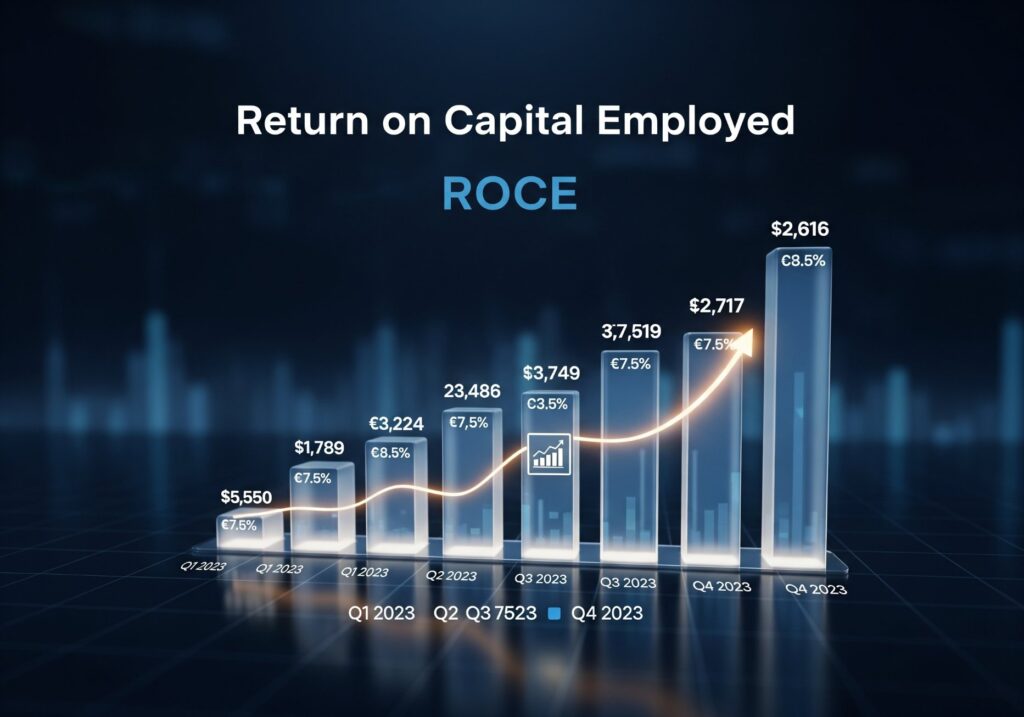
- Above 15% → Excellent efficiency (especially for established firms).
- 10–15% → Average performance.
- Below 10% → May signal inefficiency or over-investment.
Always compare ROCE with industry peers, as capital requirements differ between sectors.
💬 Related Reads for Smarter Investing
- 📊 Learn how Price-to-Earnings (P/E) Ratio helps identify undervalued stocks.
- 💰 Explore the Price-to-Book (P/B) Ratio to understand market value vs book value.
- 📈 Understand Earnings Per Share (EPS) and its link to profitability.
- 🏦 Want to diversify globally? Read International ETFs for Indian Investors.
- 💡 Compare ETF vs Mutual Fund for long-term wealth creation.
- 💸 Check how SIP Investment Plans can help you build wealth gradually.
❓ FAQs
Q1: What is a good ROCE for Indian companies?
A: Generally, anything above 15% is considered strong, though capital-heavy industries may have lower benchmarks.
Q2: Can ROCE be negative?
A: Yes, if a company’s operating profit (EBIT) is negative, it indicates inefficient capital use.
Q3: Should investors use ROCE alone to pick stocks?
A: No. Use it alongside other metrics like P/E, Debt-to-Equity, and Net Profit Margin for balanced analysis.
⚠️ Disclaimer
This article is for educational purposes only and is not financial advice. Stock market investments carry risk. Please consult a qualified financial advisor before making investment decisions.