

📈 Introduction: Why Every Investor Must Understand Key Financial Ratios
Investing in the stock market can be rewarding — but it’s also risky if you don’t understand what you’re buying. Before you put your hard-earned money into any stock, it’s crucial to know how to evaluate its financial health, profitability, and long-term potential.
That’s where key financial ratios come into play.
Financial ratios are like a company’s report card — they help investors quickly assess whether a business is performing well or struggling. These metrics reveal insights about valuation, debt, growth, and efficiency — allowing you to make data-driven investment decisions instead of relying on market noise or short-term trends.
In this detailed guide, we’ll break down the Top 10 Key Ratios Every Investor Should Know Before Buying a Stock, explain what they mean, how to calculate them, and how to use them for smarter investing.
Whether you’re a beginner trying to understand stock analysis or an experienced investor refining your portfolio strategy, mastering these ratios is essential for long-term wealth creation.
🏆 1. Price-to-Earnings (P/E) Ratio — Valuation at a Glance
Formula: P/E = Market Price per Share / Earnings per Share (EPS)
The P/E ratio is one of the most commonly used metrics for stock valuation. It indicates how much investors are willing to pay today for one rupee of earnings.
- A high P/E ratio suggests that investors expect high future growth.
- A low P/E ratio may indicate undervaluation — but it could also mean the company is facing challenges.
For example, if a company’s share price is ₹400 and its EPS is ₹20, the P/E ratio is 20. That means investors are paying ₹20 for every ₹1 the company earns annually.
Investor Tip: Always compare a company’s P/E with its peers in the same sector — a low P/E in tech might mean underperformance, but in manufacturing, it could signal value.
📘 Related Read: ETF vs Mutual Fund: Which is Better for Long-Term Wealth Creation?
💰 2. Earnings Per Share (EPS) — The Profitability Powerhouse
Formula: EPS = Net Profit / Number of Outstanding Shares
EPS reveals how much profit the company makes per share of stock. It’s one of the primary indicators of a company’s profitability and growth potential.
If Company A earns ₹10 crore in profit and has 1 crore outstanding shares, its EPS = ₹10.
A higher or consistently growing EPS indicates strong performance and can attract long-term investors.
Investor Tip: Track EPS growth over multiple quarters — steady growth signals reliability, while erratic EPS trends could be a red flag.
💵 3. Price-to-Book (P/B) Ratio — Market Value vs. Net Worth
Formula: P/B = Market Price per Share / Book Value per Share
This ratio compares a company’s market price to its book value — essentially what the company would be worth if all its assets were sold.
- P/B < 1: May indicate the stock is undervalued.
- P/B > 3: Could mean overvaluation.
For financial and asset-heavy sectors like banks and real estate, the P/B ratio is one of the most reliable valuation indicators.
Example:
If a company’s share trades at ₹100 and its book value per share is ₹80, the P/B = 1.25 — reasonable depending on the industry.
📊 4. Return on Equity (ROE) — Profitability from Shareholders’ Money
Formula: ROE = Net Income / Shareholders’ Equity × 100
ROE measures how effectively a company uses shareholders’ capital to generate profits.
- A high ROE (15–20%) indicates efficient management.
- A low ROE (<10%) could signal inefficiency or overcapitalization.
For instance, if a company earns ₹50 crore and its equity is ₹250 crore, its ROE is 20%. That’s a strong indicator of efficiency.
Investor Tip: Compare ROE within the same industry — for example, banking ROEs are naturally higher than those in utilities.
💼 5. Debt-to-Equity (D/E) Ratio — Balancing Risk and Reward
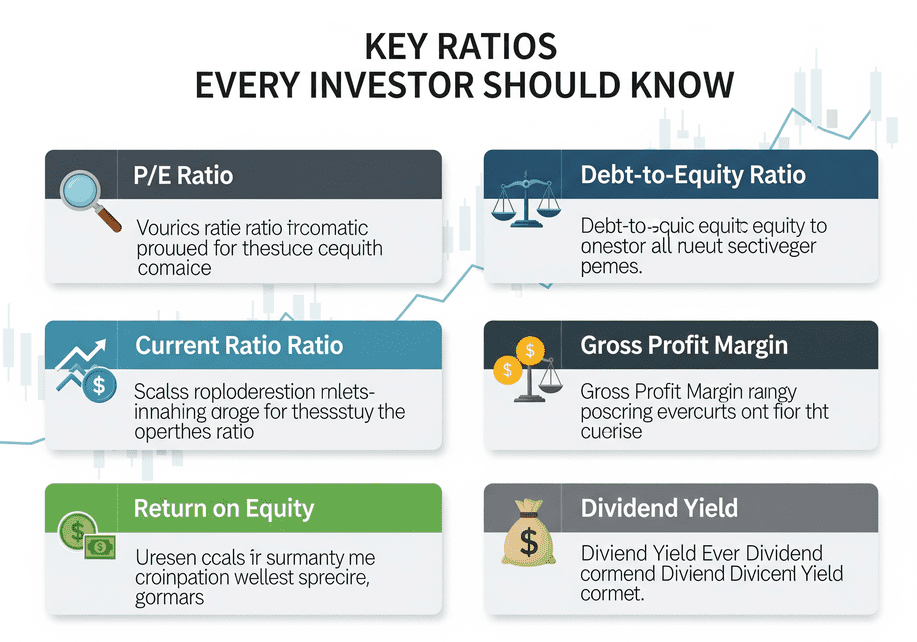
Formula: D/E = Total Debt / Shareholders’ Equity
This ratio tells you how much of a company’s financing comes from debt versus equity.
- D/E < 1: Financially stable.
- D/E > 2: Over-leveraged, risky.
A company with too much debt may struggle during downturns, while too little may mean it’s not leveraging growth opportunities.
Example:
If Company X has ₹100 crore in debt and ₹200 crore in equity, its D/E = 0.5 — indicating a healthy balance.
💧 6. Current Ratio — Liquidity Check
Formula: Current Ratio = Current Assets / Current Liabilities
This measures a company’s ability to meet short-term obligations.
- Ideal range: 1.5 – 2.0
- <1: Possible liquidity issues.
- >3: Inefficient asset use.
A current ratio of 2 means the company has twice the assets needed to cover liabilities, indicating a comfortable short-term position.
📈 7. Net Profit Margin — Efficiency in Action
Formula: Net Profit Margin = Net Profit / Revenue × 100
This ratio reveals how much profit remains after all expenses, taxes, and interest.
- High margin: Efficient cost control or strong pricing.
- Low margin: Competitive or high-cost industry.
Example:
If revenue = ₹500 crore and profit = ₹50 crore, Net Profit Margin = 10%.
Consistent margins reflect strong management and market leadership.
⚙️ 8. Return on Capital Employed (ROCE) — Measuring True Efficiency
Formula: ROCE = EBIT / Capital Employed × 100
ROCE helps assess how efficiently a company generates profits from its total capital (debt + equity).
- >12–15% is considered good in most industries.
It’s especially useful when comparing companies with different capital structures.
Example:
A company with ₹50 crore EBIT and ₹300 crore capital employed → ROCE = 16.6% — strong efficiency.
💸 9. Dividend Yield — Steady Income Indicator
Formula: Dividend Yield = Annual Dividend per Share / Market Price per Share × 100
This ratio shows how much dividend income you receive relative to the share price.
A high dividend yield means steady returns, ideal for conservative investors, while low or no yield may suggest a growth-oriented company reinvesting profits.
Example:
If a company pays ₹5 dividend and its share price is ₹200 → Dividend Yield = 2.5%.
📊 10. Price-to-Sales (P/S) Ratio — Evaluating Revenue Strength
Formula: P/S = Market Cap / Total Revenue
This ratio is helpful for evaluating companies that are not yet profitable, like early-stage tech startups.
A low P/S (<2) may suggest undervaluation, while a high P/S (>5) could indicate overpricing unless supported by high growth.
Example:
If a company’s market cap is ₹1,000 crore and revenue is ₹500 crore, its P/S = 2 — moderate valuation.
🧾 Bonus: Summary Table of Top 10 Key Ratios
| Ratio | Purpose | Ideal Range | Use Case |
|---|---|---|---|
| P/E Ratio | Valuation | <25 (sector-wise) | Compare valuations |
| EPS | Profit per share | Higher = better | Profit trend |
| P/B Ratio | Market vs Book Value | <1.5 | Asset-heavy sectors |
| ROE | Profitability | >15% | Efficiency |
| D/E Ratio | Leverage | <1 | Risk level |
| Current Ratio | Liquidity | 1.5–2 | Short-term health |
| Net Profit Margin | Profitability | >10% | Efficiency |
| ROCE | Capital Efficiency | >12% | Productivity |
| Dividend Yield | Income | >2% | Dividend stocks |
| P/S Ratio | Sales Valuation | <2 | Growth companies |
💹 How to Use These Ratios in Stock Analysis
Understanding ratios is one thing; applying them is another. Here’s how to make them work for you:
- Compare across competitors – Analyze ratios of peer companies in the same sector.
- Track trends over time – Consistent improvement signals stability.
- Combine multiple ratios – Use a mix of profitability, valuation, and leverage metrics for a holistic view.
- Avoid extremes – Very high or very low values may indicate underlying issues.
- Use with qualitative factors – Assess management quality, industry potential, and economic conditions.
🧭 Final Thoughts
Understanding the top 10 key ratios every investor should know can transform the way you invest. These metrics act as your compass — helping you distinguish between fundamentally strong businesses and risky bets.
Financial ratios aren’t about predicting stock prices — they’re about understanding the company behind the stock. Whether you’re analyzing blue-chip giants like Infosys or upcoming mid-cap stars, these ratios will guide your decision-making.
Combine them with patience, discipline, and consistent research, and you’ll be on the path to long-term wealth creation.
❓ FAQs on Key Ratios for Investors
1. What are the most important financial ratios for stock investors?
The P/E ratio, ROE, and D/E ratio are the most critical — they reveal valuation, profitability, and financial risk.
2. Can beginners use financial ratios to pick stocks?
Yes! Ratios simplify complex financial data, making stock analysis easier even for first-time investors.
3. Which ratios are best for long-term investing?
Focus on ROE, ROCE, and EPS growth — they reflect sustained performance and shareholder returns.
4. Are high P/E stocks always overvalued?
Not necessarily. Growth companies often have higher P/E ratios due to future profit potential.
5. Where can I find these ratios for Indian stocks?
You can find real-time financial ratios on Moneycontrol, Screener.in, NSE India, or Yahoo Finance.
⚠️ Disclaimer
This article is intended for informational and educational purposes only and should not be construed as financial or investment advice. Past performance is not indicative of future results. Investors are advised to conduct their own research or consult with a certified financial advisor before making any investment decisions. Busyshell and its authors are not responsible for any financial losses that may arise from using the information presented in this blog.