

As of October 2025, United States federal debt is around $37.85–$37.88 trillion, with roughly $30.3 trillion held by the public and about $7.57 trillion in intragovernmental holdings. Gross federal debt is roughly 119–125% of GDP in mid‑to‑late 2025, while debt held by the public is near 100% of GDP by multiple baselines.
📊 Current Snapshot: United States Federal Debt Nears $37.9 Trillion

As of October 2025, United States federal debt stands between $37.85–$37.88 trillion, including roughly $30.3 trillion held by the public and $7.57 trillion in intragovernmental holdings.
📈 Gross federal debt equals around 119–125% of GDP, while publicly held debt nears 100% of GDP, based on multiple baselines — levels unseen since World War II.
🏛️ What the Debt Includes
Gross federal debt = Debt held by the public + Intragovernmental holdings.
- Intragovernmental holdings include trust funds such as Social Security and Medicare.
- Debt held by the public includes marketable and nonmarketable Treasuries owned by domestic investors, the Federal Reserve, and foreign holders — the key gauge for macroeconomic analysis.
📈 Why the Debt Is Rising
Rising United States federal debt 2025 is driven by:
- Persistent primary deficits — spending exceeds revenue before interest.
- Demographic pressures — an aging population inflates Social Security and Medicare costs.
- Higher interest rates — increasing the cost of refinancing.
- Policy expansions — fiscal measures that raise baseline spending without offsetting reforms.
🧭 Related read: ETF vs Mutual Fund – Which Is Better for Long-Term Wealth Creation?
💸 Interest Costs at Record Highs
Net interest payments are projected to reach about $1 trillion in FY2025, marking multi-decade highs relative to GDP.
Analysts estimate interest expenses will consume 3–4% of GDP over the next decade if trends persist — squeezing room for public investments and social priorities.
📘 You may also like: Importance of Expense Ratio in Mutual Funds
⚖️ Debt Ceiling and Credit Ratings
To prevent default, Congress raised the 2025 debt limit from $36.1 trillion to $41.1 trillion via the One Big Beautiful Bill Act.
However, this move only delayed—not solved—the nation’s structural fiscal imbalance.
📉 Current sovereign ratings:
- Fitch: AA+ (downgraded in 2023)
- S&P: AA+ (since 2011)
- Moody’s: Aaa with a negative outlook
📐 Measuring Sustainability
Economists monitor sustainability through key ratios like: Debt-to-GDP=DebtGDP×100%Debt\text{-}to\text{-}GDP = \frac{Debt}{GDP} \times 100\%Debt-to-GDP=GDPDebt×100%
and the interest-to-revenue ratio — the share of government income spent on debt servicing.
If the effective interest rate (r) persistently exceeds real GDP growth (g), debt ratios rise unless fiscal balances improve.
🔮 Projections Through the 2030s
Independent CBO-based analyses project:
- Debt held by the public: surpassing 107% of GDP by 2029
- Gross federal debt: approaching ~155% of GDP by 2055
📊 2025 baseline updates show higher deficits across the next decade absent significant fiscal policy changes.
🧮 Policy Options That Matter
| Approach | Effect | Challenges |
|---|---|---|
| Raise tax revenues | Improves primary balance, slows debt accumulation. | Political resistance and complex reform design. |
| Reform entitlements | Reduces long-term spending growth in Social Security and Medicare. | Public pushback and transition costs. |
| Cut discretionary spending | Offers near-term deficit relief. | May affect services and economic growth. |
| Boost productivity | Expands GDP, lowering debt ratios. | Requires long-term structural investment. |
🌍 Who Owns the United States Federal Debt?
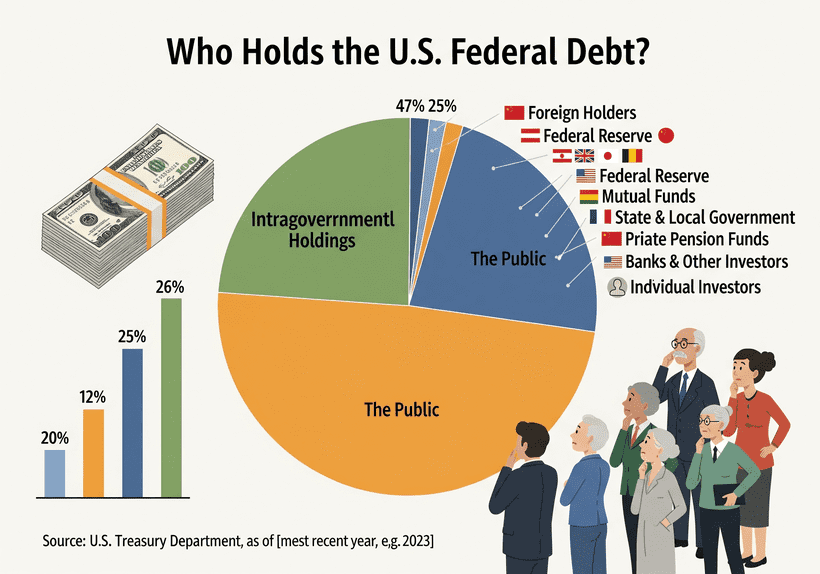
Private and institutional investors hold about two-thirds of total debt — approximately $24.4 trillion (as of March 2025).
The remaining portion is owed internally to federal accounts.
🌐 Among foreign holders:
- Japan: ≈ $1.1 trillion 🇯🇵
- China: ≈ $0.75 trillion 🇨🇳
Treasury’s TIC data confirms that while global demand for Treasuries remains strong, the composition of foreign ownership continues to evolve.
🏗️ Why Debt Sustainability Matters
High and rising United States federal debt limits fiscal flexibility during downturns and can push up risk premia on Treasury securities.
Elevated interest burdens also risk crowding out essential investments in infrastructure, education, and innovation — key to maintaining long-term growth.
🌐 External reference: IMF – Debt Sustainability Analysis Framework
💹 Investor and Market Implications
Rising United States federal debt 2025 could influence:
- Bond yields (upward pressure on real rates)
- Equity valuations (via risk and interest cost channels)
- Currency movements (due to shifts in global demand for Treasuries)
Market volatility may rise as rating risks, interest costs, and foreign participation interact in complex ways.
📎 Explore more:
- International ETFs for Indian Investors – Global Diversification Made Easy
- Gold ETF vs Physical Gold – Which Is the Smarter Investment?
- Mutual Funds vs Fixed Deposits – Which Is Better?
🧾 Disclaimer
This content is for informational and educational purposes only and does not constitute financial advice.
Figures and projections are based on publicly available data from the U.S. Treasury, CBO, and other economic analyses as of October 2025. Actual fiscal outcomes may differ based on market conditions and policy changes.